Yes. The previous version is too structured and sounds AI-generated. I’ll make it more natural, conversational, practical, and human, while keeping the SEO keywords naturally included.
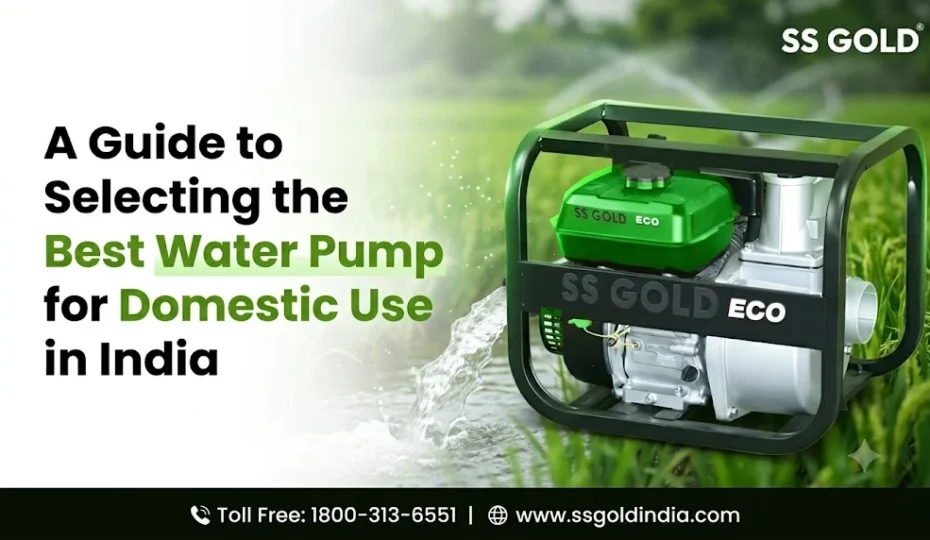
A Guide to Selecting the Best Water Pump for Domestic Use in India
Water is something every household needs every day, but getting a regular water supply is not always easy. In many Indian homes, water needs to be transferred from a sump, underground tank, borewell, or other source to an overhead tank. This is where a good domestic water pump becomes important.
But choosing a water pump is not as simple as buying the one with the highest horsepower. The right pump for your home depends on several things, such as the water source, the height of your building, the distance of the pipeline, and how much water your family uses.
If you are planning to buy a water pump for home use, this guide will help you understand what to look for before making a decision.
Why Is Choosing the Right Water Pump Important?
A water pump may look like a simple machine, but choosing the wrong one can create problems.
If the pump is too small, it may take a long time to fill your overhead tank or may not provide enough water on the upper floors. On the other hand, buying a pump that is much more powerful than you actually need can increase your electricity bill without giving you any real benefit.
A properly selected pump can give you:
- Smooth and reliable water flow
- Faster overhead tank filling
- Better water pressure
- Efficient electricity consumption
- Fewer maintenance problems
- Longer pump life
So, before buying a pump, it is worth spending a little time understanding your actual requirement.
What Type of Water Pump Do You Need?
There are different types of water pumps available in the Indian market. The best option depends mainly on where your water is coming from and where you want to send it.
1. Centrifugal Water Pump
Centrifugal pumps are commonly used for domestic water transfer. They work well when you need to move water from a tank or sump to an overhead tank.
They are a practical option for many houses because they are relatively simple to operate and maintain.
A centrifugal pump can be suitable for:
- Filling overhead tanks
- Moving water between tanks
- Residential water supply
- Small domestic applications
However, you should always check the pump’s head and flow capacity before buying.
2. Self-Priming Water Pump
If your pump is installed above the water source, priming can sometimes become a problem. This is where a self-priming water pump can be useful.
A self-priming pump is designed to remove air from the suction line and establish water flow more easily than a conventional pump in suitable installation conditions.
These pumps are commonly considered for homes where water needs to be lifted from a sump or underground storage tank.
3. Submersible Water Pump
A submersible pump is designed to operate underwater. These pumps are commonly used for borewells and deeper water sources.
If your home depends on borewell water, a submersible pump may be a better choice than a surface pump.
However, don’t select a submersible pump just by looking at its horsepower. Borewell depth, water level, required discharge and pipe size all need to be considered.
4. Pressure Booster Pump
Sometimes the problem is not getting water into the house—the problem is low water pressure.
If you have enough water but the shower, kitchen tap or other outlets have weak pressure, a water pressure booster pump may be worth considering.
This type of pump is generally used to improve pressure in domestic plumbing systems.
How to Choose the Best Water Pump for Your Home
There is no single pump that can be called the best for every household. The right choice depends on your home and your water system.
Here are the main things you should check.
1. Know Where Your Water Is Coming From
Start with the simplest question: Where will the pump take water from?
It could be:
- An underground sump
- A ground-level tank
- A borewell
- A well
- A storage tank
- Another water source
For example, if you are transferring water from an underground tank to an overhead tank, a domestic centrifugal or self-priming pump may be suitable depending on the installation.
For a deep borewell, you will normally need to look at submersible pump options.
Knowing your water source will immediately narrow down your choices.
2. Check the Height You Need to Lift the Water
One of the most important things people often overlook is the head of the pump.
Suppose your water tank is on the roof and your pump is installed near ground level. The pump has to push the water upward to reach the tank.
But the vertical height isn’t the only thing that matters. Water also loses pressure while travelling through pipes, bends, valves and other fittings.
Therefore, don’t select a pump based only on the height of your building. Look at the manufacturer’s recommended head and flow specifications.
3. Think About How Much Water You Need
Your family’s water requirement also matters.
A house with two people will obviously have a different requirement from a house with eight or ten people.
Think about how many bathrooms, taps, washing machines and other water outlets are being used in your home.
Also consider how quickly you want your overhead tank to fill.
If you want the tank to fill in a short time, you will need a pump with an appropriate flow rate.
4. Don’t Choose a Pump Only by Horsepower
When people go to buy a water pump, one of the first questions they usually ask is, “How many HP is the pump?”
Horsepower is important, but it isn’t the only specification you should look at.
A higher-HP motor does not automatically mean better performance.
For example, installing a very powerful pump in a small house may simply result in higher electricity consumption without solving any real problem.
Instead, consider the complete combination of:
Motor power + head + flow rate + pipe size + water source
This will give you a much better idea of whether the pump is right for your home.
What Does Pump Head Mean?
If you are new to water pumps, the word “head” can sound confusing.
In simple terms, pump head tells you how effectively a pump can move water against the required height and system resistance.
For example, imagine your underground tank is at ground level and your overhead tank is on the roof. The pump needs to lift water to that height.
Now add the length of the pipeline, bends and fittings. All of these affect the pump’s performance.
This is why two houses with the same number of floors may still require different pumps.
What About Pipe Size?
Your pipe size can also affect how well your water pump performs.
If the pipe is too small for the required flow, there can be greater friction and pressure loss. A long pipeline with many bends can also make the pump work harder.
Before installing a pump, check the recommended suction and delivery pipe sizes given by the manufacturer.
A good pump with poor plumbing installation may still fail to deliver the expected performance.
Which Water Pump Is Best for an Overhead Tank?
For many homes, the common requirement is to move water from a sump or ground-level tank to an overhead tank.
In this situation, a centrifugal water pump or self-priming water pump can be considered, depending on the installation.
The final selection should be based on:
- Height of the overhead tank
- Distance between the tank and pump
- Suction conditions
- Required water flow
- Pipe diameter
- Number of floors
- Household water requirement
If you are unsure, sharing these details with the pump manufacturer or a qualified technician can help you select the correct model.
Which Is Better: 0.5 HP or 1 HP Water Pump?
This is one of the most common questions when buying a domestic water pump.
The answer is: it depends on your requirement.
A 1 HP pump is not necessarily better than a 0.5 HP pump for every home. If your water requirement and lifting height are low, a smaller pump may be sufficient.
If the water has to travel a greater distance or reach a higher floor, you may need a pump with greater capacity.
So instead of asking only, “Which has more HP?”, ask:
“Which pump can provide the required flow at my required head?”
That is a much better way to select a pump.
How to Save Electricity While Using a Water Pump
Nobody wants to see a higher electricity bill because of a water pump.
The good news is that proper pump selection and installation can help avoid unnecessary energy consumption.
Here are a few simple things you can do:
- Choose the pump according to your actual requirement.
- Avoid using an unnecessarily high-HP pump.
- Check your pipes regularly for leakage.
- Don’t allow the pump to run unnecessarily.
- Keep the pump and plumbing system properly maintained.
- Follow the manufacturer’s installation instructions.
- Use automatic controls or a suitable water-level control system where appropriate.
Remember, an efficient pump is not simply one with a low power rating. It is a pump that does the required job efficiently.
Common Mistakes People Make When Buying a Water Pump
Buying the biggest pump available
More power doesn’t always mean better performance. An oversized pump can waste electricity.
Looking only at horsepower
Head and flow are equally important. Always consider the complete pump specification.
Ignoring the water source
A pump suitable for a storage tank may not be suitable for a deep borewell.
Forgetting about pipe length
Long pipelines and several bends can affect water flow and pressure.
Choosing without checking installation conditions
The same pump may perform differently depending on how and where it is installed.
Ignoring after-sales service
Even a good pump may eventually need servicing. Check whether reliable service and spare parts are available in your area.
Simple Water Pump Maintenance Tips
Once you install your pump, a little regular care can make a big difference.
Keep an eye on the pump and notice if anything changes. If the pump suddenly becomes unusually noisy, vibrates heavily, gets too hot or starts delivering less water, don’t ignore it.
You should also:
- Check for water leakage around pipes and connections.
- Keep electrical connections properly protected.
- Check the suction and delivery lines for blockages.
- Avoid dry running unless the pump is specifically designed for it.
- Follow the manufacturer’s maintenance schedule.
- Get professional help if the pump develops a serious problem.
Regular maintenance is usually much easier and cheaper than waiting for a major breakdown.
Final Words
Finding the best water pump for domestic use in India doesn’t mean choosing the most expensive or most powerful model. It means finding a pump that matches your home’s actual water requirement.
Before buying, look at the water source, required head, flow rate, motor power, pipe size, number of floors and installation conditions.
If you are replacing an old pump, it can also be helpful to understand why the previous pump was not performing well. Sometimes the problem isn’t the pump itself—it could be a leaking pipe, blocked suction line, incorrect pipe size or an unsuitable installation.
Take the time to compare the specifications and choose a pump based on your actual requirement. A correctly selected water pump can provide dependable water supply to your home while helping you avoid unnecessary electricity and maintenance costs.
The best water pump is not the biggest one—it is the one that fits your home’s needs.