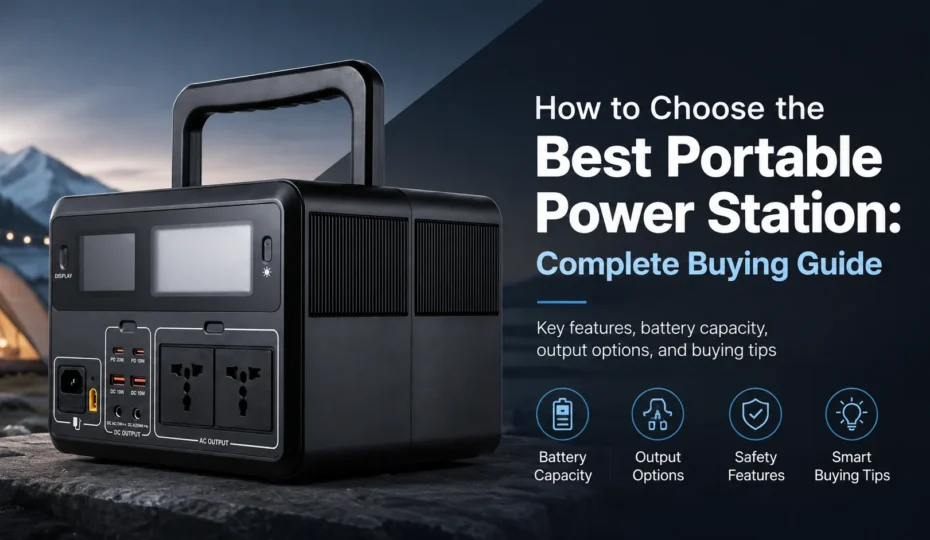
How Do You Choose the Best Portable Power Station?
The best portable power station would be that which meets your power requirements rather than one with the largest battery capacity. This can be achieved through calculating your watt-hour (Wh) requirements, adding 20–30% extra battery capacity, ensuring that its continuous output wattage is enough to run your devices, and finally comparing battery chemistry, charging modes, port types, portability, solar compatibility, and warranty.
Just for an initial idea, 300–500Wh might be enough for casual camping, 500–1000Wh for drone pilots and light professional needs, 800–1500Wh for remote working and power outage support, whereas 2000Wh might be needed in some more demanding commercial uses.
The basic point is very straightforward: there is no single “best” portable power station for everyone. The best portable power station is the one that suits your needs.
What Is a Portable Power Station?
Portable power station is a rechargeable battery-powered equipment that holds electricity and delivers power from AC outlets, USB-A, USB-C, and DC port connections.
It can be described as a massive power bank with an inverter.
In case of certain models, it can be charged by means of:
- An electrical outlet
- Compatible solar panels
- Automobile charging point
Possible uses of a power station include laptops, mobile phones, camera devices, lighting fixtures, Wi-Fi, camping accessories, drones, and compatible small appliances.
In comparison with fuel-powered generators, portable power station does not require gasoline or diesel to function.
What Are the First 3 Questions You Should Ask Before Buying?
Before comparing brands or prices, answer these three questions:
1. What devices do you want to power?
Make a complete list.
For example:
- Laptop
- Wi-Fi router
- Smartphone
- Camera
- Drone charger
- LED lights
- Portable fan
- Mini refrigerator
2. How long do you need backup?
Do you need power for:
- 2 hours?
- 6 hours?
- 8 hours?
- An entire working day?
- A multi-day camping trip?
3. Do you need portability?
A photographer carrying equipment between locations has very different requirements from someone keeping a power station permanently at home.
These three answers help determine the two most important specifications: battery capacity (Wh) and output power (W).
How Much Battery Capacity Do You Actually Need?
Battery capacity is measured in watt-hours (Wh).
What Does Wh Mean?
Watt-hours inform you of the amount of electrical power that a battery can hold.
In layman’s terms:
Higher Wh means greater potential backup.
However, just because something has higher Wh ratings does not mean you should necessarily get it.
Instead, work out your need.
How Do You Calculate Portable Power Station Capacity?
This is done using the following simple calculation:
Energy Need (Wh) = Device Power Consumption (W) × Run Time (Hours)
Work out this for each appliance you will be charging and sum up the values.
Also, add an extra 20–30% for efficiency purposes.
Example
Suppose you need:
Laptop:
65W × 6 hours = 390Wh
Camera charger:
30W × 3 hours = 90Wh
LED light:
20W × 4 hours = 80Wh
Your total requirement is:
390 + 90 + 80 = 560Wh
Add a 25% buffer:
560 × 1.25 = 700Wh
A power station around the 700Wh class or above would therefore be a more appropriate starting point for this example.
Actionable Step
Before searching for the best portable power station, create a simple table:
| Device | Wattage | Hours | Energy Needed |
|---|---|---|---|
| Laptop | 65W | 6 | 390Wh |
| Camera charger | 30W | 3 | 90Wh |
| LED light | 20W | 4 | 80Wh |
| Total | 560Wh | ||
| +25% buffer | ≈700Wh |
This one calculation can prevent you from buying an undersized power station.
What Is the Difference Between Wh and W?
This is one of the key concepts that one needs to grasp.
Wh = Battery Capacity
Watt-hours (Wh) indicates the amount of energy contained.
It mainly impacts the runtime of your devices.
W = Output Power
Watts (W) indicates the amount of load the power station can support in a particular moment.
It determines the appliances one can run on that device.
For instance, take a power station with a big 1500 Wh battery capacity but only 500W continuous AC output.
Just because the battery capacity is high does not mean one can use a 1000 W appliance.
Remember:
Wh = How long?
W = What can it run?
Which Portable Power Station Is Best for Camping?
In terms of a recreational camp-out experience, a 300-500Wh portable power station would be an appropriate range to start with in terms of charging low-power devices like:
- Smartphones
- LED torches
- Cameras
- Fans
- Any other suitable camping gadgets
For prolonged off-the-grid trips, the combination of 500-1000Wh with proper solar charging is more versatile.
Actionable Step for Campers
Focus on:
Lightness + carrying handle + USB-C + solar charging + sufficient Wh capacity.
No need to purchase a heavy 2000Wh power station for a weekend charging of phones and cameras.
Which Portable Power Station Is Best for Photographers and Filmmakers?
Professional photographers and filmmakers will have totally different needs compared to average campers.
Here is what you may have to charge:
- Camera battery packs
- LED lights
- Strobe equipment
- Laptop
- Monitor
- Smartphone
- Other production accessories
The advice provided indicates the range of 1000-1500Wh to be an appropriate range for professional photography and filming purposes.
Noise should not be overlooked either.
An overheating fan can become too noisy during certain shooting sessions, which means that the professional should test the cooling fans and the level of noise produced.
Actionable Step for Artists
Take stock of the number of your gadgets to be charged and make sure there are enough USB-C PD and AC outputs.
What Portable Power Station Is Suitable for Drone Operators?
The drone pilot will often have to charge a number of batteries within the same outdoor session.
A power station with a capacity of 500 to 1000Wh may be an appropriate choice based on the drone, charger, battery numbers, and how frequently you will be charging them.
But there are other factors besides capacity that matter too.
Make sure that the output from the power station is compatible with the one suggested by the drone manufacturer.
Actionable Step
Charge the drone batteries using the charger recommended by the drone manufacturer and use the power station as the electricity supply.
What Portable Power Station Is Best for Home Power Cuts?
A portable power station can also provide backup for essential household electronics.
For example:
- Wi-Fi router
- Laptop
- Smartphones
- LED lights
- Compatible fans
- Other low-to-medium-power electronics
For remote work and recurring outages, the supplied guidance suggests roughly 800–1500Wh, depending on your actual load and desired backup duration.
Example
Suppose your setup uses:
- Laptop = 60W
- Router = 15W
- 2 LED lights = 20W
Total:
95W
If you want 8 hours of backup:
95 × 8 = 760Wh
Adding a 25% buffer:
≈950Wh
A roughly 1000Wh-class power station would therefore be a logical starting point for that specific setup.
Actual runtime will vary with device consumption, battery operating limits, and conversion losses.
Is LiFePO4 Better Than Lithium-Ion for a Portable Power Station?
Battery chemistry may have a major impact on ownership over time.
What Is LiFePO4?
LiFePO4 refers to Lithium Iron Phosphate.
This is a battery chemistry in lithium batteries commonly used in current portable energy storage devices.
According to the source, LiFePO4 is recommended for frequent use since it has better rated cycle life than lithium-ion batteries.
When Should You Consider LiFePO4?
LiFePO4 may be more desirable if you are going to use your power station:
- Often for emergency backup at home
- Frequently for professional use
- For camping often
- In a business
- For frequent charging and discharging cycles
- Actionable Step
Don’t just say “lithium battery”.
Find out:
Battery chemistry → Rated cycle life → Battery warranty
Which Ports Should a Good Portable Power Station Have?
Good ports will be relative to your gear.
Seek out a proper combination of:
AC Outlets
For regular plug-in devices and converters.
USB-A
For typical electronic gadgets.
USB-C PD
Especially good for compatible:
- Smartphones
- Laptops
- Cameras
- Tablets
- And other contemporary electronic gadgets.
- DC Output
Good for compatible car and camping equipment.
Additionally, as per the guide provided, the pass-through charging is recommended, which is the capacity of charging the compatible devices while being used at the same time.
Action Step
Take a picture of all the chargers and plugs you use.
Compare that to the ports available in the portable charger.
Seems like a no-brainer, but it will help save you from buying an unnecessary number of adapters along with your charger.
How Important Is Portability?
Very important—if you actually intend to carry the unit.
Higher battery capacity usually means greater weight.
A power station with 2000Wh of capacity could be preferred over another with only 500Wh, until the requirement is carrying it for kilometers to an outdoor place.
It is explicitly mentioned in the purchasing advice that you should not overlook the issue of weight as bigger power stations would become too difficult to carry.
Ask Yourself:
Am I going to carry it daily?
Then give preference to weight.
Am I going to keep it inside my house?
Then weight might be secondary to capacity.
Am I going to keep it inside a vehicle?
What Common Mistakes Should You Avoid?
First-time buyers often make a few predictable mistakes.
Mistake 1: Looking Only at Wh
A large battery doesn’t guarantee that a high-power appliance can run.
Check output wattage too.
Mistake 2: Ignoring Battery Cycle Life
Two similarly priced units can have very different long-term battery characteristics.
Mistake 3: Buying Too Much Capacity
More isn’t always better if portability matters.
Mistake 4: Ignoring Solar Compatibility
If you plan to add solar later, verify compatibility before purchasing the power station.
Mistake 5: Ignoring Warranty and Service
Check whether reliable after-sales support is available where you live.
These are also among the key first-time-buyer mistakes highlighted in the buying guidance.
How Do You Choose the Best Portable Power Station Step by Step?
Use this practical process:
Step 1: List every device you need to power.
Step 2: Write down each device’s wattage.
Step 3: Estimate how many hours each device will operate.
Step 4: Calculate total Wh requirement.
Step 5: Add a 20–30% capacity buffer.
Step 6: Check the highest simultaneous wattage.
Step 7: Check surge requirements for motor/compressor-based appliances.
Step 8: Choose an appropriate battery chemistry.
Step 9: Check AC, USB-C, USB-A, and DC outputs.
Step 10: Decide whether you need solar charging.
Step 11: Compare weight and portability.
Step 12: Compare warranty and after-sales support.
If a model passes all 12 checks, it is far more likely to fit your actual needs than one selected simply because it has the biggest number on the specification sheet.
Conclusion: Which Is the Best Portable Power Station?
There is no one-size-fits-all best portable power station.
A backpacker may need a light 300-500Wh unit. A drone pilot may want to have quick charging and multiple outlets. A photographer needs a lot of power – 1000Wh+ and longer usage period. For the household – steady supply for the router, laptop, lights, etc. For business purposes – 2000Wh+ and significantly higher wattage.
Therefore, it’s better to ask not:
“What portable power station has the largest battery?”
But rather:
“How much power do I need? For which devices? For how long?”
Knowing this information, the decision-making process becomes easier.
Frequently Asked Questions
1. How many Wh do I need for a weekend camping trip?
For basic weekend camping involving phones, lights, and a small compatible fan, 300–500Wh can be a useful starting range. Your actual requirement depends on the devices and usage time.
2. Can a portable power station charge a laptop and camera together?
Yes, if the unit has suitable outputs and their combined load remains within its maximum output rating.
3. Is LiFePO4 good for a portable power station?
LiFePO4 can be a strong option for frequent use because of its high rated cycle-life potential and thermal characteristics.
4. Can I use a portable power station during a power cut?
Yes. A correctly sized power station can support compatible essential electronics such as a laptop, Wi-Fi router, lights, and smartphones during an outage.
5. Can a portable power station be charged using solar panels?
Yes, if the model supports solar input and the solar panel matches its supported voltage, current, wattage, and connector specifications.
6. How long will a 1000Wh portable power station last?
Runtime depends on your load. As a simple theoretical example, a 100W load would suggest roughly 10 hours from 1000Wh before accounting for conversion losses and usable-capacity limits. Real-world runtime will therefore be lower.
7. Can I charge drone batteries from a portable power station?
Yes, provided the drone charger and power station are electrically compatible. The supplied guidance recommends using the drone’s proper charger and using the station as the power source.
8. Can I take a portable power station on a flight?
Large portable power stations can exceed airline battery limits. Battery restrictions depend on watt-hour capacity and airline/regulatory rules, so check the current policy of your airline before travelling.