Introduction
Starting a business is always a big decision. Before investing money, every entrepreneur wants to know one thing: Is this business worth it?
If you are looking for a business opportunity in India, the agricultural machinery industry is worth considering. Agriculture continues to support millions of people across the country, and farmers need reliable equipment to carry out their daily work.
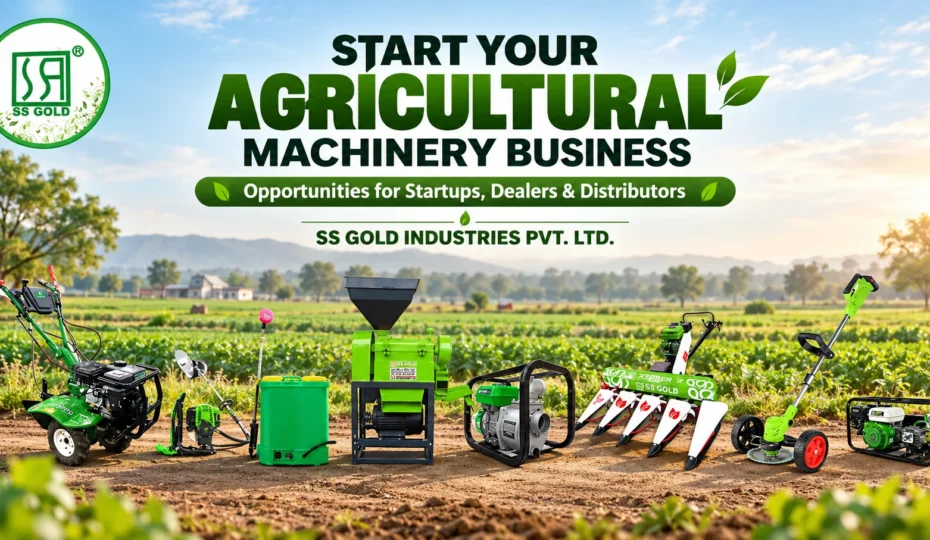
From preparing the land to maintaining crops, agricultural machines help farmers save time and reduce manual effort. As a result, there is a market for different types of farming equipment, including power tillers, brush cutters, sprayers, water pumps, and other agricultural tools.
The good thing is that you do not necessarily need to start with a large investment. You can begin with a small agricultural equipment shop, work as a dealer, or gradually build a distribution business.
Let’s understand why the agricultural machinery business can be a good opportunity for entrepreneurs at different stages.
1. Farmers Need Agricultural Machinery Regularly
Farming is not a one-time activity. Farmers need different types of equipment throughout the growing season, depending on the crops they cultivate and the work they need to complete.
For example, a farmer may need a power tiller for land preparation, a sprayer for crop care, or a brush cutter to manage grass and unwanted vegetation.
Buying the right machinery can help farmers complete these tasks more efficiently. This creates opportunities for businesses that supply dependable agricultural equipment.
For a new entrepreneur, the first step is to understand the needs of farmers in the local area. Find out which machines are commonly used, what customers can afford, and which products are difficult to find nearby.
Instead of stocking every type of machine from the beginning, start with products that have a realistic chance of selling in your target market.
2. You Can Start Small and Grow Gradually
One of the advantages of this industry is that you can choose a business model according to your budget and experience.
You do not have to build a factory or purchase a large amount of machinery to get started.
Here are a few options worth exploring:
- Agricultural equipment shop: Sell farming tools and selected machines directly to farmers.
- Dealership business: Partner with an established agricultural machinery brand and sell its products.
- Distribution business: Supply machinery to retailers and smaller dealers.
- Online business: Promote agricultural equipment through your website, social media, and suitable online marketplaces.
- Spare parts business: Sell replacement parts and accessories that farmers regularly need.
For example, someone starting in a small town could begin by selling a few popular products and build relationships with local farmers. Once sales become more consistent, they can introduce additional products and expand their customer base.
Starting small allows you to learn about the market before committing more money to the business.
3. There Is Room for Medium-Sized Businesses Too
If you already have experience in trading, retail, or distribution, agricultural machinery could be another area to explore.
A medium-sized business can work with manufacturers, appoint local dealers, and supply products to multiple towns or districts.
It can also offer a wider range of equipment instead of depending on just one product category.
For example, a business selling agricultural machinery could gradually add sprayers, brush cutters, power tillers, pumps, and compatible spare parts based on customer demand.
However, growth should be planned carefully. Before expanding, make sure you have reliable suppliers, enough working capital, proper stock management, and a way to handle customer complaints or service requirements.
A larger product range can create more sales opportunities, but only when the products match the needs of your customers.
4. Large Startups Can Explore Manufacturing and Distribution
For entrepreneurs with greater investment capacity and technical knowledge, the opportunities can extend beyond retail and dealership operations.
They may consider manufacturing, product assembly, warehousing, large-scale distribution, or developing their own agricultural equipment brand.
These business models require more planning, investment, skilled people, and quality control. Manufacturing, in particular, involves responsibilities such as product testing, sourcing components, managing production, and meeting applicable regulations.
Businesses that build reliable products and strong dealer networks can work towards serving a larger market over time.
The important thing is to choose a model that matches your resources. A small dealership and a manufacturing unit may operate in the same industry, but their investment requirements and business risks are very different.
5. Selling Machines Is Not the Only Way to Earn
A common mistake is to focus only on the profit earned from selling a machine.
In reality, an agricultural machinery business may have other ways to generate revenue, depending on its capabilities and customer requirements.
For example, you can sell spare parts and accessories, provide maintenance services if you have trained technicians, or supply products in bulk to other dealers.
After-sales support can also help build customer loyalty. When farmers know where to find suitable replacement parts or get their equipment serviced, they may be more likely to return to the same business.
Of course, these services involve their own costs. You need to consider technician salaries, spare parts inventory, warranty arrangements, and other expenses before deciding which services to offer.
The goal should be to build a business that customers trust, rather than relying only on individual sales.
6. Government Schemes May Create Additional Opportunities
The Indian government and various state governments introduce programmes related to agricultural development and farm mechanisation. Depending on the scheme, eligible farmers may receive financial assistance for approved agricultural equipment.
For agricultural machinery dealers, such programmes can sometimes influence customer demand.
However, subsidies are not available for every product or every buyer. The rules, eligible machinery, assistance amounts, and application procedures depend on the particular scheme.
If you plan to sell equipment connected with a subsidy programme, check the latest official guidelines before making any claims to customers.
A business should be built on genuine product demand and good service, not on the assumption that every customer will receive financial assistance.
7. Digital Marketing Can Help You Find More Customers
In the past, many agricultural equipment businesses depended mainly on local shops, personal contacts, and word-of-mouth recommendations.
These methods are still valuable, but digital marketing gives businesses another way to reach potential customers.
Even a small agricultural machinery dealer can create a website or social media page to display products, explain their uses, and receive enquiries.
Here are some practical ways to get started:
Create a website: List your products with clear photographs, specifications, and contact details.
Work on SEO: Publish useful articles targeting searches such as “agricultural machinery manufacturer in India,” “power tiller price,” and “agricultural equipment dealer near me.”
Use Google Business Profile: Help nearby customers discover your business through accurate contact details, photographs, and genuine customer reviews.
Share product videos: Demonstrate how a machine works, what it is used for, and what customers should consider before buying it.
Use social media: Share product updates, farming tips, customer feedback, and information about new equipment.
Generate dealer enquiries: If you want to expand your distribution network, create a dedicated page for prospective dealers and distributors.
Digital marketing does not guarantee immediate sales. However, when done consistently, it can help people discover your business and make it easier for interested customers to contact you.
8. Understand the Costs Before Investing
Agricultural machinery can offer business opportunities, but it is important to calculate your expenses before investing.
Let’s take a simple example.
Suppose you purchase a machine for ₹15,000 and sell it for ₹20,000.
Your gross profit would be ₹5,000, assuming these are the relevant purchase and selling prices and excluding other costs.
But that ₹5,000 is not necessarily the amount you take home.
You may still need to pay for transportation, rent, staff, advertising, financing, warranty expenses, and other operating costs.
For this reason, it is important to understand the difference between gross profit and net profit.
Gross Profit = Selling Price − Direct Product Cost
Gross Margin = (Gross Profit ÷ Selling Price) × 100
In this example, the gross margin is 25%. Your actual net profit will be lower after accounting for other expenses.
Before starting, prepare a basic business plan covering your investment, monthly expenses, expected sales, stock requirements, and cash flow.
Also, remember that unsold inventory can tie up your money. Buying stock according to actual demand is often safer than purchasing large quantities simply to offer more products.
9. What Challenges Should You Prepare For?
Every business has challenges, and agricultural machinery is no exception. Knowing what to expect can help you avoid some common mistakes.
Seasonal sales: Demand can change with crop cycles, weather, and local farming practices. Plan your stock accordingly.
Competition: Other dealers may sell similar products. Focus on product knowledge, dependable service, and fair pricing.
Stock management: Too much inventory can block working capital, while too little can cause you to miss sales.
Customer support: Farmers may need help understanding machine operation, maintenance, and warranty conditions.
Supplier reliability: Delayed deliveries or inconsistent product quality can affect your reputation.
Changing customer needs: Equipment that sells well in one region may not be suitable for another. Research your local market before expanding.
You do not need to solve every challenge on day one. Start with a manageable operation, learn from your customers, and improve your business as you grow.
10. Choosing the Right Manufacturer Makes a Difference
Even if you have a good business plan, choosing the wrong supplier can create problems with product quality, delivery, pricing, and customer service.
Before working with an agricultural machinery manufacturer, compare the product range, specifications, commercial terms, warranty policies, spare parts availability, and support offered to dealers.
It is also helpful to understand which products are suitable for the farming practices and budgets of your target customers.
SS Gold Industries Pvt. Ltd. operates in the agricultural machinery sector and offers an option for businesses interested in exploring agricultural equipment and potential dealership opportunities.
If you are considering working with SS Gold Industries, review the available products and discuss the relevant business terms with the company before making an investment.
A reliable supplier, combined with a good understanding of the local market, can help you build a stronger foundation for your business.
Conclusion
So, is the agricultural machinery business profitable in India?
It can be, provided you choose the right business model, understand your customers, control your costs, and work with dependable suppliers.
A small entrepreneur may begin with a local agricultural equipment shop. A growing business may expand into dealership and distribution, while a larger company may explore manufacturing and wider market expansion.
There is no single formula for success. What matters is starting with proper research, investing carefully, and offering products that solve real problems for farmers.
If you are planning to enter this industry, take time to understand your local market, calculate your investment, and compare potential suppliers before getting started.
Looking for agricultural machinery for your business?
Explore the products and business opportunities available through SS Gold Industries Pvt. Ltd.
Website: https://ssgoldindia.com/
Customer Support: 1800-313-6551
Frequently Asked Questions
1. Is the agricultural machinery business a good option for beginners?
It can be a good option for beginners who research their local market and start with a manageable investment. A small retail or dealership model may be easier to manage initially than manufacturing.
2. How much investment is required to start an agricultural machinery business?
The investment depends on the business model, location, inventory, shop expenses, supplier terms, and working capital. It is best to prepare a budget based on your specific plan rather than rely on a single estimated amount.
3. Which agricultural machines should I sell first?
Start by finding out what farmers in your area actually need. Depending on local farming practices, you could consider sprayers, brush cutters, power tillers, pumps, and related accessories.
4. How can I increase sales of agricultural machinery?
Build relationships with farmers and local dealers, maintain a useful online presence, provide accurate product information, and offer dependable after-sales support. Product demonstrations and genuine customer recommendations can also help.
5. Can I become a dealer for an agricultural machinery manufacturer?
Yes, some manufacturers offer dealership or distribution opportunities. Contact the company to understand its eligibility criteria, investment requirements, product availability, and commercial terms.
6. Is manufacturing better than dealership?
Neither is automatically better. Dealership generally involves selling products sourced from manufacturers, while manufacturing requires additional investment in production, technical expertise, quality control, and operations. Choose according to your resources and experience.
7. Can digital marketing help a small agricultural machinery business?
Yes. A website, local search visibility, social media, and useful product videos can help potential customers discover your business. The results depend on your market, product offering, and marketing strategy.