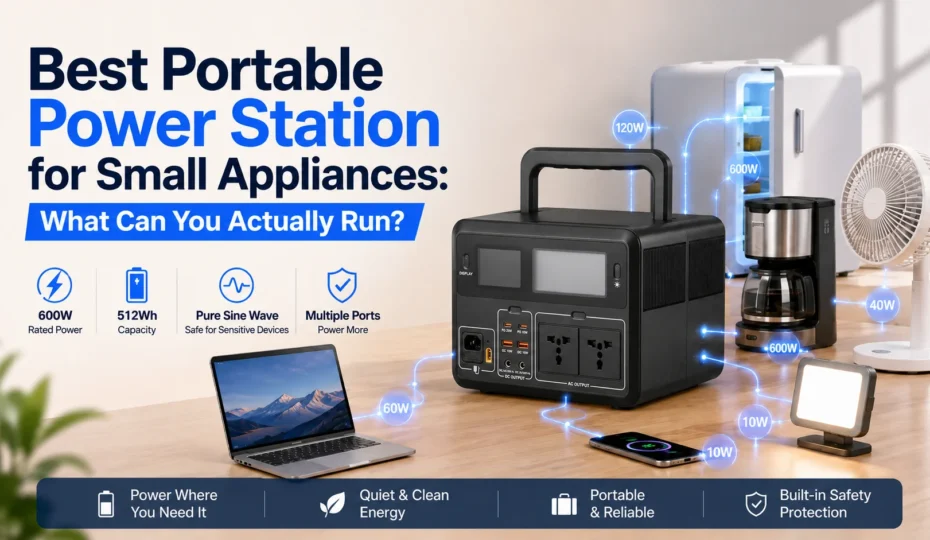
Yes, a portable power station can run many everyday small appliances. A battery capacity ranging from 500 to 1000 Wh will be enough to run laptops, smartphones, Wi-Fi routers, camera chargers, drone batteries, LEDs, mini-fridges, and some kitchen appliances during a limited period of time. To run energy-intensive appliances like induction cookers or refrigerators for extended time frames, use 1500-2000Wh or higher battery capacity. The simple formula is:
Appliance Wattage × Usage Hours = Required Battery Capacity (Wh).
The trick here is not in getting the largest power station but getting the right one.
What Is a Portable Power Station?
The portable power station is a portable battery pack that contains an inverter to convert the power stored in batteries to electricity that can be used to charge everyday appliances.
It’s like a large power bank able to power up:
- Computers
- Smartphones
- Cameras
- Wi-Fi routers
- Mini-refrigerators
- LED lights
- Compact kitchen appliances
- Drones
Modern power stations have:
- AC sockets
- USB-A sockets
- USB-C PD sockets
- DC sockets
- Vehicle sockets
They are perfect for home use, traveling, camping, photography, working outside and emergencies.
What Do Watts and Watt-Hours Mean?
Many buyers get confused between watts and watt-hours.
What Are Watts (W)?
Watts measure how much power an appliance consumes at a particular moment.
Examples:
- Laptop: 45–90W
- Wi-Fi Router: 5–15W
- Mini Fridge: 60–100W
- Blender: 300–500W
What Are Watt-Hours (Wh)?
Watt-hours measure how much energy a battery can store.
In simple terms:
Watts = What you can run
Watt-hours = How long you can run it
Example
If you have:
- 500Wh Power Station
- 50W Laptop
Runtime calculation:
500 ÷ 50 = 10 hours (theoretical)
Real-world runtime is usually slightly lower due to inverter efficiency losses.
Why Are Surge Watts Important?
This is among the most common errors committed by new buyers.
Certain electrical appliances need additional energy at startup.
Examples of such appliances are:
- Refrigerators
- Blenders
- Induction Stoves
- Pumps
Such appliances can momentarily consume up to 2–3 times the wattage needed while operating.
Example
A refrigerator could operate on 100 watts, but it needs additional energy at the moment of startup.
In the case where you have a power generator that cannot cope with the extra demand for power, then the appliance will not be able to start, despite being suitable for running wattage.
Actionable Advice
When making purchases, ensure you know the:
- Continuous Output Wattage
- Peak/Surge Output Wattage
Can a Portable Power Station Run Kitchen Appliances?
Yes, but runtime depends heavily on wattage.
Common Kitchen Appliances
| Appliance | Approx. Power Consumption |
|---|---|
| Mini Fridge | 60–100W |
| Blender | 300–500W |
| Rice Cooker | 400–700W |
| Electric Kettle | 1000–1500W |
| Induction Cooktop | 1200–2000W |
Higher-wattage appliances drain batteries quickly.
Example
An energy storage device that powers a mini fridge can be used for many hours in a mid-size power plant, whereas an induction cooktop might use up much energy in a little while.
Actionable Tip
If you need to power a food truck, stall, or mobile kitchen:
- High battery capacity
- High sustained output
- Rapid charging
Can a Portable Power Station Run Camera and Drone Equipment?
Absolutely.
This is probably one of the most common use cases.
A portable power station may help to:
- Charge DSLR batteries
- Charging Mirrorless camera batteries
- Drone batteries charging
- LED video lights
- Laptops for editing purposes
Portable power stations are often used by photographers as quieter alternatives to generators.
Example
A 500Wh power station will be able to recharge camera and drone batteries several times while shooting outdoors.
Actionable tip
For half-day shooting outdoors, pack enough capacity to support your:
- Camera batteries
- Drone batteries
- Laptop
- Lighting accessories
Is a Portable Power Station Good for Remote Work?
Yes.
In case you do remote working or travel a lot, the power station will ensure your critical devices have power in case there is any power outage.
Typical Office Setup
- Computer/Laptop
- Wi-Fi Router
- Mobile Phone
- Monitor
Since the power requirements are pretty minimal, power stations are perfect for use by:
- Work-from-home workers
- Nomadic workers
- Freelancers
- Remote workers
A medium-sized power station can even support an entire office setup for a few hours.
Actionable Tip
Features to look for:
- USB-C PD Charging
- Quick Recharge capability
- Silent Cooling
Can a Portable Power Station Help During Power Cuts?
Yes, definitely.
Portable power stations have become quite common as an option for home backup power.
These devices can be used to power:
- LED lighting
- Wi-Fi routers
- Cell phones
- Laptops
- Fans
- Mini-refrigerators
This becomes very handy during monsoon outages.
Actionable Tip
Keep your portable power station in a cool and dry place.
Which Portable Power Station Capacity Is Best for You?
Choosing the right capacity depends on your use case.
| Use Case | Recommended Capacity |
|---|---|
| Camping | 500–800Wh |
| Photography | 300–500Wh |
| Drone Operations | 300–500Wh |
| Remote Work | 300–500Wh |
| Home Backup | 800–1500Wh |
| Food Truck | 1500–2000Wh+ |
| Trade Shows | 500–1000Wh |
Different users have different needs, so capacity should be based on actual device requirements rather than marketing claims.
Is LiFePO4 Better Than Lithium-Ion?
Battery chemistry matters.
LiFePO4 (lithium iron phosphate)
Pros:
- Lifespan is long
- Higher cycle life
- Higher thermal stability
- More suitable for constant usage
- Lithium-Ion Battery
Pros:
- Lighter weight
- Cheaper price
For those that need frequent use, LiFePO4 is more popular because it will provide many more charge cycles than traditional Lithium-Ion.
Action Item
Always consider when buying:
- Type of battery
- Cycle life
- Warranty period
when buying.
How Do You Calculate Your Power Requirements?
Follow this simple process:
Step 1
List all appliances you want to run.
Step 2
Check the wattage of each appliance.
Step 3
Add the wattage of devices that will run simultaneously.
Step 4
Multiply by the number of hours you need backup.
Step 5
Add a 20% buffer.
Example
Laptop = 60W
Router = 10W
Phone Charging = 15W
Total Load:
85W
Required for 6 Hours:
85 × 6 = 510Wh
Add 20% buffer:
≈ 610Wh
A power station around this capacity would be a suitable starting point.
What Mistakes Should You Avoid?
Many buyers make these common mistakes:
Ignoring Surge Power
Running watts and surge watts are not the same.
Choosing Only by Battery Size
A bigger battery isn’t always necessary.
Ignoring Weight
Large-capacity units can be difficult to carry.
Overlooking Solar Charging
Solar compatibility can be valuable for outdoor users.
Ignoring Warranty and Service Support
Reliable support becomes important over long-term ownership.
Conclusion
It is entirely dependent upon your needs as to which is the best portable power station for your small appliances.
In case you require a portable power station for:
- Laptops
- Routers
- Smartphones
- Cameras
- LED Lights
you should generally go for a 500-1000Wh portable power station.
In case of refrigerators, mobile food trucks, induction cooking, and home backup, higher capacity portable power stations would do better.
Prior to purchase, consider the following calculation:
Total Wattage x Usage Hours = Needed Wh Capacity
Adding a margin and considering continuous and surge power would help you select the ideal portable power station.
Frequently Asked Questions
1. Can a portable power station run a refrigerator?
Yes. A mini-fridge can typically run on a suitable power station, but you must also consider surge power requirements.
2. How long will a 500Wh portable power station last?
It depends on the connected load. Lower-power devices like routers and lights can run much longer than high-power appliances.
3. Can I charge a portable power station with solar panels?
Yes, many modern power stations support solar charging when used with compatible solar panels.
4. Is LiFePO4 better for Indian weather conditions?
LiFePO4 batteries are often preferred for frequent-use scenarios due to their longevity and thermal characteristics.
5. Can a portable power station run an induction cooktop?
Yes, but induction cooktops require high output power and can drain batteries quickly.
6. Can I use a portable power station for work-from-home backup?
Absolutely. They are ideal for laptops, routers, phones, and other low-power office equipment.
7. What is the best battery type for a portable power station?
LiFePO4 is generally considered a strong option for users seeking longer battery life and frequent usage.
8. How do I know what size power station to buy?
Calculate the wattage of your devices, multiply by the number of hours you need backup, and add a 20% safety buffer.