Is LiFePO4 Portable Power Station Worth Buying?
Yes, because if you require a portable power station that you will use frequently at home, camping, photography, drone charging, outdoors, or your work, then the LiFePO4 power station battery technology is one of the best to buy. The term LiFePO4 means lithium iron phosphate, which is highly rated for its longevity, heat resistance, and charging/discharge.
When buying a LiFePO4 power station, there are several factors other than battery chemistry that you need to take into consideration. These factors include capacity (Wh), continuous output (W), Battery Management System (BMS), charging efficiency, solar compatibility, ports, portability, and warranty.
In summary, capacity refers to how much energy your power station has, output is about what can be powered, and battery chemistry greatly affects performance.
What Is a LiFePO4 Power Station?
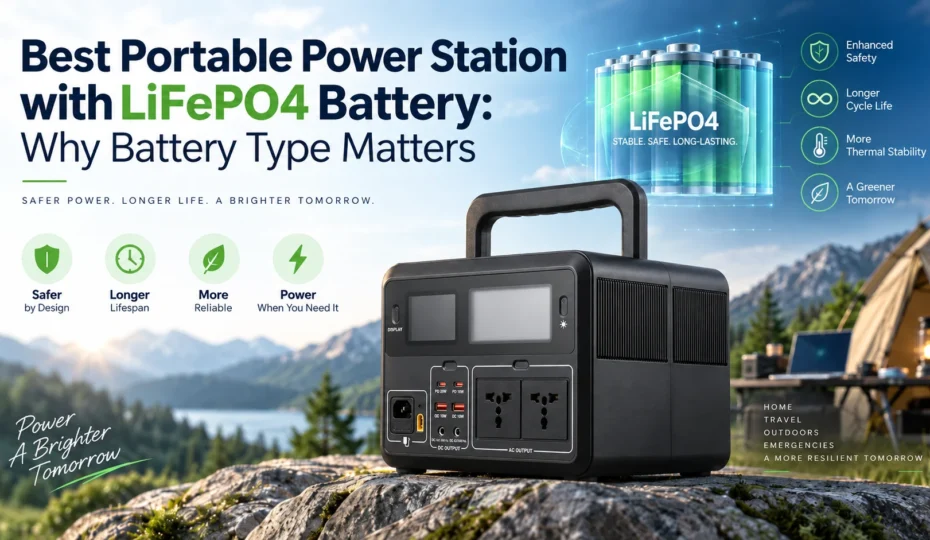
A LiFePO4 power station refers to a portable rechargeable energy storage system with a Lithium Iron Phosphate battery.
The components that characterize a portable power station include:
- Battery storage
- Inverter
- AC sockets
- USB-A and USB-C sockets
- DC sockets
- Charging circuitry
- Battery Management System
LiFePO4 power station differs from the rest of the lithium-ion battery chemistries due to the chemical composition of the batteries.
To put it simply, when you intend to charge/discharge your portable power station often, battery chemistry will become one of the most critical factors.
What Is the Difference Between LiFePO4 and Lithium-Ion Batteries?
Although LiFePO4 is technically part of the broader lithium-ion battery family, buyers commonly compare LiFePO4 (LFP) with conventional lithium-ion chemistries such as NMC.
Here is a simple comparison:
| Factor | LiFePO4 (LFP) | Conventional Li-ion/NMC |
|---|---|---|
| Cycle-life potential | Higher | Generally lower |
| Thermal stability | Higher | More heat-sensitive |
| Weight | Often slightly heavier | Often lighter |
| Upfront cost | Usually higher | Usually lower |
| Frequent-use suitability | Excellent | Depends on application |
| Portability | Good | Often better for weight-sensitive uses |
The source material cites approximately 3,000–5,000 cycles for LiFePO4 versus 500–800 cycles for the compared NMC configuration, although actual manufacturer ratings vary by cell design, depth of discharge, temperature, charging behavior, and end-of-life definition.
Actionable Step
When comparing two products, don’t just check whether both say “lithium battery.”
Look specifically for:
Battery Chemistry → Rated Cycles → Remaining Capacity at Rated Cycles → Warranty
That gives you a much more meaningful comparison.
Why Does Battery Cycle Life Matter?
Battery cycle life is the number of charge-discharge cycles a battery can perform before its available capacity falls to a particular level.
This is important since a portable power station is not a single-use product.
Let’s consider two scenarios involving users of the power station:
User A: Uses the power station five times a year for camping.
User B: Uses it almost every day for a shop, for doing photography, or for home backup needs.
Cycle life becomes extremely important in the case of Scenario B since the power station will be charged and discharged multiple times daily.
Illustration: Why Cost Per Cycle Is Important
In a purely illustrative manner:
The Power Station A costs ₹40,000 and offers 3,500 rated cycles.
₹40,000 ÷ 3,500 ≈ ₹11.43 per rated cycle
The Power Station B costs ₹20,000 and offers 600 rated cycles.
₹20,000 ÷ 600 ≈ ₹33.33 per rated cycle
These calculations ignore factors such as capacity differences, financing charges, electricity charges, degradation, and residual value but show why the lowest selling price may not translate into the lowest lifetime cost.
Actionable Point
In case of frequent use of the power station, compare cost per usable Wh over the life of the battery.
Is LiFePO4 Safer for a Portable Power Station?
Chemical properties of LiFePO4 cells are greatly appreciated due to their high thermal stability.
Nevertheless, battery chemistry isn’t the only factor that impacts safety of the product.
A good power station should also feature a quality Battery Management System (BMS).
What Is a BMS?
BMS is an acronym for Battery Management System.
It electronically controls and manages the battery pack and may include a number of protection mechanisms in case of the following conditions:
Overcharging
Over-discharge
Overcurrent
High temperature
Short circuit
This purchasing advice especially stresses the importance of good BMS as one of the safety factors of LiFePO4 power stations.
Actionable Step
Never go for a power station just because it says “LiFePO4” on its product page.
Does LiFePO4 Matter in Hot Weather?
Temperature may impact the functioning and life cycle of rechargeable batteries.
It is especially important when you use a portable power station:
- Outdoors
- At exhibitions
- In cars
- In roadside stands
- In summer
- In poorly ventilated places
The heat properties of LiFePO4 make it ideal for challenging conditions; however, any portable power station should never be intentionally subjected to excessive heat and direct sunlight.
Actionable Step
Make sure you keep your power station:
- Protected from direct sunlight
- In a ventilated place
- Protected from water
- Protected from hot enclosed environments
- Within the temperature range recommended by the manufacturer
Never think that a heat-stable battery composition protects your device from overheating completely.
Does LiFePO4 Charge Faster Than Lithium-Ion?
Not necessarily.
The battery chemistry is not the only factor that determines the charging speed of a portable power station.
The factors that affect charging time include:
- AC input wattage limit
- Battery capacity
- Charging hardware
- Thermal regulation
- Solar input limit
- Manufacturer charging limitations
Both LiFePO4 and other lithium-ion portable power stations are capable of fast charging based on their design.
Example
A 1000Wh battery with high charging input is able to recharge at a much faster rate compared to a smaller battery with low input limit.
This means you should not just ask:
“Can it fast charge?”
Instead ask:
“What is the maximum charging input and how long does it take to recharge?”
Which LiFePO4 Power Station Is Best for Camping?
When going on a short camping or road trip, a portable power station with a battery capacity of 300 to 600Wh of LiFePO4 is good to consider.
It can be used for:
- Phone charging
- Laptop charging
- Camera batteries
- LED lights
- Portable fan
- Appliances that can work with the unit
Solar charging comes handy during multi-day trips in an off-grid area.
Actionable Step for Campers
Consider the following:
Light weight + carrying handle + LiFePO4 + USB-C PD + compatible solar charging
If you plan on hiking or carrying the unit around manually, do not go for too much battery capacity.
Why Is a LiFePO4 Power Station Useful for Photographers?
Many wedding photographers, videographers, and content producers are likely to use multiple devices during the course of their day.
Some of these devices may include:
- Camera batteries
- Laptop
- Batteries for drones
- LED Lights
- Monitor
- Smartphones
- Audio equipment
A battery having high-rated cycle life will be of great value when a power station is used frequently for professional work.
Example
Suppose you shoot three times per week and then charge the power station at the end of each job.
This adds up to hundreds of charge cycles over several years.
Thus, in such cases, the choice of a power station made purely based on lower cost is not recommended.
Is LiFePO4 Good for Drone Operators?
Yes, especially if the power station is regularly charged and discharged.
The drone pilot will be required to charge various batteries during one deployment at the field. This constitutes a tough duty cycle for which battery cycle life becomes crucial.
However, the battery type does not affect whether you can plug your drone charger.
Also consider:
- Wattage of the charger
- AC/DC output specifications
- Continuous output of the power station
- Available ports
- Total load
Actionable Step
Plug your drone into the charger designed by the drone manufacturer whose input specifications are within the power station’s output specifications.
Is a LiFePO4 Power Station Good for Home Backup?
Absolutely yes. The LiFePO4 power station is useful in ensuring that essential electronics are powered during blackouts.
Based on its capacity and output, one may be able to power the following:
- Wi-Fi router
- Laptop
- Smartphones
- LED light bulbs
- Other compatible fans
- Other small appliances
For essential back-up needs, a 500-1000Wh power station can be a good start, although the actual need will depend on your appliances and how long you need the back-up system to operate.
Example
Suppose you need:
Laptop = 60W
Router = 15W
LED lights = 20W
Total load:
95W
For 6 hours:
95W × 6 = 570Wh
Adding a 25% buffer:
≈713Wh
You could therefore start comparing power stations around the 700–800Wh class or above for this particular scenario.
How Do You Calculate the Right Power Station Capacity?
Use this simple formula:
Required Wh = Appliance Watts × Hours of Use
If multiple appliances will operate together, calculate each one and add the results.
Then allow extra capacity for conversion losses and a practical operating buffer.
Example
Laptop:
60W × 5 hours = 300Wh
Router:
15W × 5 hours = 75Wh
Lights:
20W × 5 hours = 100Wh
Total:
475Wh
Add 25% buffer:
≈594Wh
A 600Wh-class or larger power station would therefore be a sensible starting point for this example.
Actionable Step
Don’t start your search with a product.
Start with a load calculation.
That prevents both undersizing and unnecessary overspending.
Should a LiFePO4 Power Station Have Solar Charging?
If you need off-grid or emergency charging, solar compatibility can be extremely useful.
It is particularly relevant for:
- Camping
- Remote work
- Outdoor shoots
- Road trips
- Long outages
- Remote business operations
Look for a model with compatible solar input and, where provided, an MPPT charge controller.
What Is MPPT?
MPPT stands for Maximum Power Point Tracking.
It is a charging technology designed to optimize energy harvesting from compatible solar panels under changing solar conditions.
Actionable Step
Before connecting a solar panel, match:
Panel voltage + current + wattage + connector
with the power station’s supported solar-input range.
Never assume that any solar panel can be connected to any power station.
What Features Should You Check Before Buying a LiFePO4 Power Station?
Use this buying checklist:
1. Calculate capacity (Wh).
Determine how much energy you actually need.
2. Check continuous output (W).
Make sure it can handle your simultaneous appliance load.
3. Check surge output.
Important for appliances with compressors or motors.
4. Confirm LiFePO4 chemistry.
Don’t rely only on a generic “lithium” description.
5. Check rated cycle life.
Compare the manufacturer’s exact specification.
6. Check BMS protection.
Look for clearly documented battery protections.
7. Check charging options.
AC, car, USB-C, and solar can provide greater flexibility.
8. Check ports.
Make sure there are enough AC, USB-C, USB-A, and DC outputs for your equipment.
9. Check portability.
Capacity is useful only if the product still fits your intended use.
10. Check warranty and service.
Long battery life is more valuable when backed by dependable after-sales support.
These considerations align with the core selection process of calculating Wh requirements, verifying cycle life, checking charging inputs, pass-through support, portability, and BMS quality.
What Mistakes Should You Avoid When Buying?
Avoid these common mistakes.
Choosing Only by Wh
Battery capacity doesn’t tell you how much instantaneous load the inverter can handle.
Assuming Every Lithium Battery Is LiFePO4
Always verify the exact chemistry.
Ignoring the BMS
Battery cells are only one component of the overall system.
Ignoring Weight
LiFePO4 units can be heavier, so portability matters if you frequently carry the unit.
Ignoring Solar Compatibility
This becomes important if you plan to use the power station away from grid electricity.
Ignoring Warranty and Service
What Mistakes Should You Avoid When Buying?
Avoid these common mistakes.
Choosing Only by Wh
The capacity doesn’t indicate the instantaneous loading capability of the inverter.
Assuming Every Lithium Battery Is LiFePO4
It is important to confirm the exact chemistry of the battery cells.
Ignoring the BMS
Battery cells are just one part of the whole system.
Ignoring Weight
The LiFePO4 batteries may be heavy; hence, portability becomes an issue especially when the unit is carried around.
Ignoring Solar Compatibility
This becomes an issue when the power station is intended to run on solar power outside grid power.
Ignoring Warranty and Service
Even with a durable battery, there might still be problems with other aspects like electronics, ports, charger, fan, or even inverter.
Several of these purchase mistakes have been emphasized in the shopping guide checklist.
Is LiFePO4 Worth the Higher Initial Cost?
For users who employ them often, this can be the case.
Rather than considering only the purchase price, consider:
Purchase Price ÷ Rated Cycles
And, for a more comprehensive comparison:
Purchase Price ÷ Usable Lifetime Energy
In this way, you can gain a better perspective on value.
For a user who will employ their portable power station several times per year, a lower purchase price and reduced weight will become more significant.
For users who will employ them daily or weekly, however, the battery life cycle becomes more significant.
Conclusion: Is LiFePO4 the Optimum Battery for a Portable Power Station?
For buyers who value longevity, regular use, good thermal properties, and prolonged ownership, LiFePO4 can be considered one of the optimum battery chemistries for a portable power station.
However, battery chemistry should never be the sole criterion of your choice.
A good LiFePO4 power station should consist of the following qualities:
Right capacity + adequate power output + good BMS + proper ports + fast charging + suitability for solar power + portability + good warranty.
But above all, it is important to determine your needs.
The correct question here is not:
“Which LiFePO4 power station has the largest battery?”
It should be:
“Which LiFePO4 power station gives me the necessary capacity, power, and other qualities?”
Frequently Asked Questions
1. What does LiFePO4 mean in a portable power station?
LiFePO4 stands for Lithium Iron Phosphate, a lithium battery chemistry known for thermal stability and high cycle-life potential.
2. Is LiFePO4 better than conventional lithium-ion for power stations?
For frequent cycling and long-term use, LiFePO4 can offer important advantages, particularly in cycle life and thermal stability. Conventional lithium-ion designs may still offer benefits such as lower weight depending on the product.
3. How many cycles can a LiFePO4 power station last?
The source material uses 3,000–5,000 cycles as a typical range, but actual ratings vary by manufacturer, battery design, operating conditions, depth of discharge, and the remaining-capacity threshold used to define cycle life.
4. Is a LiFePO4 power station good for home backup?
Yes. A correctly sized unit can provide backup for compatible devices such as laptops, routers, lights, phones, and other essentials.
5. Can you charge a LiFePO4 power station with solar panels?
Yes, if the power station supports solar input and the panel is compatible with its voltage, current, wattage, and connector specifications.
6. Does LiFePO4 charge faster than lithium-ion?
Not automatically. Charging speed depends heavily on the power station’s input power, charging electronics, battery capacity, thermal management, and manufacturer limits.
7. Can I charge a laptop, drone, and camera at the same time?
Yes, provided the power station has the necessary ports and the combined power demand remains within its output limits.
8. What size LiFePO4 power station should I buy?
Calculate the wattage of each device, multiply it by the expected hours of operation, add the totals, and include a practical capacity buffer. Choose output wattage separately based on the maximum simultaneous load.