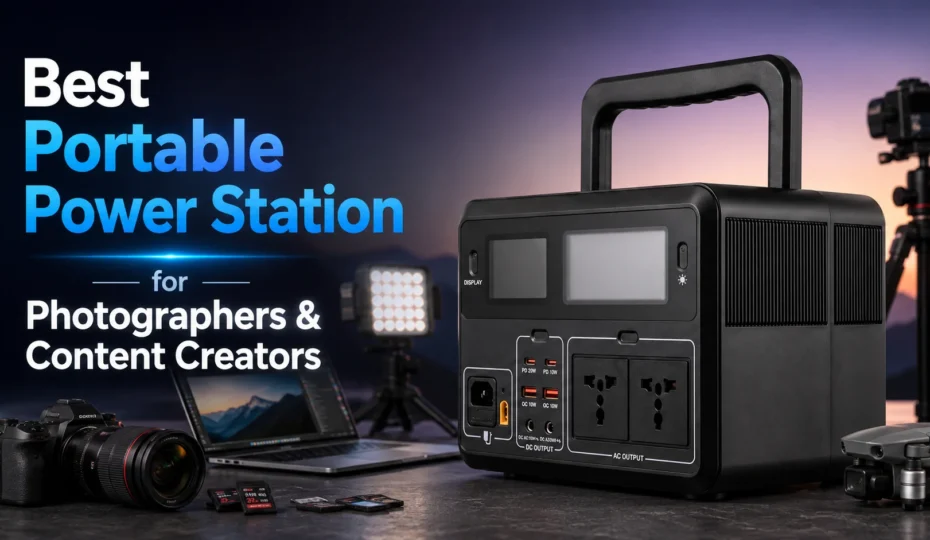
A reliable and portable power station can be one of the most important accessories for the photographer, videographer, vlogger and all the outdoor content creators. This allows you to charge your camera batteries, laptops, drones, smartphones, and some compatible lights without having access to the wall socket. While on the road trip, camping, and on-site shootings, a 512Wh, 600W LiFePO4 portable power station can provide a good combination of portability, energy capacity, and output.
Photography in these days has not been restricted to the camera and one extra battery.
An average content creator can be seen traveling with his/her mirrorless camera, drone, smartphone, laptop, wireless microphone, gimbal, LED light, and chargers.
Sab equipment ready ho sakta hai, lekin ek problem shoot ko stop kar sakta hai:
Battery khatam.
This problem becomes even more serious while shooting in mountains, forests, camping sites, farms, beaches or other locations where electricity is not easily available.
This is where a portable power station proves to be very useful.
What Is a Portable Power Station?
A power station basically means an energy storage system, which generates power and is used to charge different electronic items without connecting to the usual wall outlet.
A power station can be considered a much advanced form of the ordinary power bank.
While a typical smartphone power bank charges a phone using USB cable, the portable power station offers many types of outputs based on different models such as:
- AC outlets
- USB-A slots
- USB-C slots
- USB Power Delivery
- DC outlets
- Car-type plugs
- Solar inputs
Hence, this system has more advanced capabilities.
Apart from charging your phone, you can even use this device to charge camera batteries, laptop, drone batteries, lighting and other production accessories.
Why Do Photographers Need a Portable Power Station?
The simplest explanation comes down to this:
More shooting time.
Every electronic device runs on batteries and is limited to a certain amount of runtime.
If you work in a studio environment, it’s not really a problem since electricity will be available right there.
Outdoor photography is an entirely different situation.
Think of being on an outdoor photo shoot for a whole day.
The equipment you might have could include:
- 2 camera bodies
- 4 camera batteries
- Drone
- Smartphone
- Laptop
- GoPro camera
- Microphone (wireless)
- LED lights
By mid-day, it’s possible that some of the batteries are already going low.
Without an external power source, the only thing that remains to do is to bring enough batteries for the entire trip.
In this case, the used batteries can be charged even before the other batteries run out.
Why Is a Portable Power Station Useful for Content Creators?
The content creator may need even more electronics than a photographer.
For instance, a YouTuber or a videographer could be using at the same time:
camera + microphone + monitor + LED light + smartphone + laptop + drone.
Everything needs to be charged.
If you work outdoors during an event or traveling, you will not always be able to find six different charging places.
Portable power bank becomes your main charging point.
For example, at night, you could go back to your camping site and charge your kit for another shooting day tomorrow.
Original PDF emphasizes nighttime charging of cameras, drones, phones, laptops and microphones as an important workflow for creators.
Can You Charge Camera Batteries With a Portable Power Station?
Yes.
It is perhaps one of the easiest ways.
The battery chargers for DSLR and mirrorless cameras normally use up a fair amount of electricity.
Rather than having to lug around ten charged batteries, the photographer could have a system that rotates batteries.
For instance:
Battery A = in the camera
Battery B = spare battery
Battery C = charging from power source
When Battery A runs out of power, switch to Battery B and begin charging Battery A.
This type of rotation would make life much easier when going on long photo shoots outdoors.
Can You Charge a Laptop?
Yes, as long as the power requirements of your laptop are compatible with the outputs available from the power station.
This can be especially useful for:
- Travel photographers
- Wedding photographers
- Videographers
- YouTubers
- Drone creators
- Social media teams
For example, after completing a shoot you may want to:
Transfer the footage, make backups, edit the photos, export the content, and upload the files.
The use of all of these activities needs power from a laptop.
A portable power station enables creators to keep on working whether they are travelling or camping.
Why Is USB-C PD Important for Creators?
USB-C Power Delivery, usually called USB-C PD lets compatible devices get more charging power through USB-C.
Modern creator equipment uses USB-C charging more and more.
Depending on compatibility that may include:
- Laptops
- Tablets
- Smartphones
- Cameras
- Action cameras
- Gimbals
- Power banks
- accessories
The SS GOLD X600 PDF says it can use up to 100W USB-C PD, which is especially handy, for compatible creator equipment.
The practical benefit is simple:
chargers, fewer adapters and less cable clutter.
When carrying camera equipment all day every little simplification helps.
Can a Portable Power Station Charge Drone Batteries?
Yes, in cases that’s true.
The key thing is to make sure you understand what your specific drone charger needs.
Drone batteries tend to lose power especially when you’re taking long videos from the sky.
Imagine you’re filming the sunrise.
You take a flights in the morning and use up most of your batteries.
Of waiting until you get to a hotel you can go back to your campsite or car and plug the right charger into your portable power station.
While you get ready, for the spot your batteries can start charging.
For people who use drones a lot this can really help them take videos in a single day.
Can It Run LED Photography or Video Lights?
Many small LED lights used for taking pictures can be powered by the kind of portable power stations.
Always make sure to look at the lights wattage first.
This can be really helpful for:
- Interviews
- YouTube videos
- Product shoots
- Wedding photography
- Outdoor filmmaking
- Night photography
- Small studio setups
There is another big plus to this.
A power station that runs on batteries does not have a motor like a gas generator.
This means there is no noise, from a machine that could mess up your microphone when you are recording.
For people who make videos this can be a help.
What Do Wh and W Mean in a Portable Power Station?
These two specs confuse first‑time buyers I have seen that.
Fortunately the difference is simple I can explain it clearly.
What Does Wh Mean?
Wh means watt-hour.
Wh tells me approximately how much energy is stored inside the battery.
For example:
A 512Wh battery theoretically contains 512 watt-hours of stored energy.
A simplified runtime calculation is:
Battery capacity ÷ Device consumption
Example:
512Wh ÷ 50W = 10.24 hours theoretically.
However actual runtime will normally be lower I notice that.
Why?
Because some energy is lost through:
- Power conversion
- Inverter operation
- Battery-management systems
- Heat
- Device behaviour
- conditions
So always treat the mathematical result as an estimate rather, than a guaranteed runtime.
What Does 600W Mean?
600W refers to the power station’s output capability.
In very simple terms:
Wh = kitni total energy battery store karti hai.
W = ek time par kitni power provide kar sakti hai.
This difference matters.
A power station could have plenty of stored battery energy but still be unable to operate equipment requiring more instantaneous power than its supported output.
Always check both numbers.
Is 512Wh and 600W Enough for a Photographer?
For many solo photographers and content creators, this capacity class can be a practical option.
A typical portable creator setup may look like this:
| Equipment | Common Use |
|---|---|
| Camera batteries | Recharge between shoots |
| Smartphone | Navigation, communication and shooting |
| Laptop | Editing and file backup |
| Drone batteries | Recharge between flights |
| Action camera | Recording travel footage |
| Wireless microphone | Audio recording |
| Gimbal | Stabilized shooting |
| LED lighting | Interviews or night shoots |
| Tablet | Monitoring or editing |
However, there is no universal answer to “how many times can it charge my equipment?”
That depends on the battery capacity of every device and the efficiency of its charger.
Avoid buying purely on exaggerated claims such as:
“Runs everything for three days.”
Instead, calculate your actual requirements.
What Features Should Photographers Look for?
Battery capacity is not the thing that matters.
I have found that creators should evaluate the power system.
1. LiFePO4 Battery
LiFePO4 stands for lithium iron phosphate.
It is a battery chemistry that is widely used in portable energy systems.
I have seen that for someone who travels often and keeps charging and discharging a power station, battery chemistry and the manufacturers rated cycle life deserve attention.
A portable power station may become part of your professional equipment collection, long-term battery performance matters.
2. Pure Sine Wave Output
If you are powering electronic equipment through AC look for a pure sine wave inverter.
Photography equipment can cost lakhs of rupees.
Laptops, chargers and other electronics should ideally receive suitable AC power.
3. Multiple Charging Ports
I think one port is rarely enough, for a creator.
I know that after a shoot you may need to recharge:
- Camera
- Drone
- Phone
- Laptop
- Microphone
- Gimbal
4. Charging
A portable power station needs to recharge quickly.
Imagine you have a few hours of access to grid electricity before you head to another outdoor location.
Slow charging could become inconvenient.
So compare not battery capacity but also:
How quickly can the power station recharge?
5. Solar Charging
For photographers who spend days off-grid solar compatibility can be useful.
The basic setup is:
panel → Power station → Camera equipment
During daylight hours compatible solar panels can help replenish the power station.
Later the stored energy can be used to charge creator equipment.
This can be particularly helpful, for:
- Wildlife photographers
- Campers
- Landscape photographers
- Road-trip creators
- Documentary teams
- Outdoor YouTubers
check supported solar voltage, current and connector requirements before connecting a panel.
Is a Portable Power Station Good for Camping?
Yes.
Camping is one of the real life uses for portable battery power.
Picture yourself staying two nights at an away spot for photography.
Day 1
I take landscape photos. Shoot drone footage.
Evening
Back at the campsite:
Camera batteries → charging
Drone batteries → charging
Phone → charging
Laptop → backing up footage
Microphone → charging
Next Morning
My gear is ready, for sunrise photography.
That’s when a portable power station stops being just a nice extra and becomes part of my creator workflow.
Is It Useful for Road Trips?
Definitely.
Road-trip photographers often travel to places where reliable electricity’s hard to find.
A power station can stay in your car. Work as a mobile charging base.
This is especially helpful for:
- Travel vloggers
- Automotive photographers
- Adventure creators
- Wildlife photographers
- Documentary filmmakers
- Drone pilots
Shoot, at one spot recharge during a break head to the next.
Why Can the SS GOLD X600 Be Useful for Content Creators?
The SS GOLD X600 combines several specifications that are relevant to photographers and videographers.
- 512Wh LiFePO4 battery
- 600W pure sine wave output
- Up to 100W USB-C PD
- Fast charging
- Multiple output options
- UPS functionality
- Solar charging support
For a creator, the bigger story isn’t simply:
“It can charge a phone.”
A more useful workflow is:
Shoot → Recharge → Backup footage → Edit → Recharge gear → Shoot again
That’s what makes portable power relevant to professional and semi-professional creators.
How Should Photographers Choose the Right Power Station?
Before buying anything, create a small power checklist.
Write down every device you normally carry.
For each one, note:
Device | Charger wattage | Battery capacity | Number of expected recharges
For example:
| Device | What to Check |
|---|---|
| Camera | Charger input |
| Laptop | Charger wattage |
| Drone | Battery charger consumption |
| LED light | Running wattage |
| Smartphone | USB-C/USB charging requirement |
| Microphone | Charging method |
| Gimbal | Battery/USB requirements |
Then answer four questions.
1. What is my maximum simultaneous power requirement?
2. How many hours or days will I stay away from grid electricity?
3. Which ports do my devices require?
4. How will I recharge the power station itself?
Ye four answers milne ke baad correct model choose karna much easier ho jata hai.
Who Should Consider Buying One?
A portable power station can be especially useful for:
Travel photographers who frequently work on the road.
Wildlife photographers who spend long hours in remote areas.
Landscape photographers shooting sunrise, sunset or astrophotography.
Wedding photographers and videographers who need emergency battery backup.
Drone creators who need multiple battery recharge cycles.
YouTubers and vloggers working outside studios.
Campers who want power away from conventional electricity.
Freelance content creators who edit while travelling.
If you work almost entirely inside a well-powered studio, a portable power station may not be essential.
But if electricity availability determines whether your shoot continues or stops, portable backup power can become a valuable part of your kit.
Frequently Asked Questions
What is the best portable power station for photographers?
The best option is one that provides enough battery capacity for your expected shooting duration, sufficient wattage for your equipment, multiple charging outputs, USB-C PD where needed, reliable battery chemistry and convenient recharging options.
Is a 600W power station enough for photography?
For many camera chargers, laptops, drone chargers, USB devices and compatible LED lighting setups, 600W can be useful. Always check both individual device wattage and the total simultaneous load before connecting equipment.
Can I charge DSLR and mirrorless camera batteries?
Yes. Compatible camera battery chargers can generally be connected to an appropriate AC or USB output.
Can I charge my drone batteries?
Often yes, provided your drone’s charger requirements are compatible with the power station’s output specifications.
Can I charge a MacBook or other laptop?
Yes, if the laptop is compatible with the available USB-C PD or AC output and stays within supported power limits.
Can I use a portable power station for filmmaking?
Yes. It can support a creator ecosystem consisting of compatible cameras, monitors, microphones, laptops, smartphones, gimbals, batteries and lighting equipment.
How long will a 512Wh power station last?
It depends entirely on the connected equipment.
A basic theoretical formula is:
Battery capacity in Wh ÷ equipment wattage = approximate runtime
Actual performance will be lower because no power system is 100% efficient.
Is LiFePO4 suitable for portable power stations?
LiFePO4 is widely used in portable energy systems. Buyers should compare battery chemistry along with rated cycle life, warranty, charging performance and battery-management features.
Can a portable power station charge through solar panels?
Yes, when the model supports solar input and the solar panel is electrically compatible with the manufacturer’s specified requirements.
Is a portable power station useful for camping?
Yes. It allows campers and outdoor photographers to recharge important electronic equipment even when grid electricity isn’t available.
Can I take a 512Wh power station on an airplane?
Large lithium batteries are subject to strict aviation rules, and a 512Wh unit generally falls outside the range of an ordinary passenger power bank. Always verify current rules with your airline before travelling.
Is a Portable Power Station Better Than a Generator for Photographers?
For many small creator setups, a portable battery station can be more convenient because there’s no fuel-engine noise while recording video or audio.
A conventional generator can still be more appropriate when very high power or much longer continuous runtime is required.
So neither solution is universally better.
Your equipment and shooting environment determine the right choice.