Power cuts are still a common problem in many parts of India. Whether you are working from home, running a small shop, or simply trying to keep your fans and lights running, a good inverter can make life much easier.
Today, lithium battery inverters are becoming a popular choice because they are compact, require less maintenance, and can offer a longer battery life than traditional lead-acid systems.
If you are planning to buy a 1.4kW lithium battery inverter, this guide will help you understand how it works, what you can run on it, and what you should check before buying one.
What Is an Inverter?
An inverter is basically a backup power system. It stores electricity in a battery when the power supply is available and uses that stored energy when there is a power cut.
The battery stores electricity in DC form, while most household appliances use AC power. The inverter converts the stored DC power into AC power so that you can continue using your appliances.
Depending on its capacity, an inverter can be used to power things like:
- Fans
- LED lights
- Wi-Fi routers
- TVs
- Computers
- Set-top boxes
- Other essential electrical appliances
The number of appliances you can run depends on their total power consumption and the inverter’s capacity.
What Does a 1.4kW Inverter Mean?
A 1.4kW inverter can deliver up to around 1,400 watts of power, subject to the manufacturer’s specifications.
This makes it a useful option for homes, small offices, shops, and other places where you mainly need backup for essential appliances.
For example, you might want to run two fans, a few LED lights, a Wi-Fi router, a television, and a computer during a power cut.
Here is a simple example:
| Appliance | Approx. Power |
|---|---|
| 3 LED bulbs | 30W |
| 2 fans | 140W |
| Wi-Fi router | 15W |
| LED TV | 100W |
| Computer | 200W |
| Total | 485W |
These figures are only examples. Actual power consumption varies from one appliance to another.
It is also important to remember that some appliances, especially those with motors or compressors, can require extra power when they start.
Why Are Lithium Battery Inverters Becoming Popular?
For years, lead-acid batteries were the standard choice for home inverters. They are still widely used, but lithium battery technology has become an attractive alternative for people looking for a more modern backup solution.
Here are some of the main reasons people consider lithium battery inverters.
1. Longer Battery Life
Lithium batteries can generally provide a longer service life than conventional lead-acid batteries when they are properly designed, installed, and used.
For someone who plans to use an inverter for many years, this can make a noticeable difference.
2. Compact and Space-Saving
Lithium batteries have a high energy density, which allows manufacturers to build relatively compact backup systems.
This is especially useful if you don’t have much space at home or in your office.
3. Less Maintenance
One of the biggest advantages of lithium batteries is their low-maintenance nature.
Unlike traditional flooded lead-acid batteries, they don’t require regular electrolyte topping-up. You still need to follow the manufacturer’s instructions for charging, installation, and general use.
4. Efficient Charging
Lithium battery systems can offer efficient charging and, depending on the battery and charger specifications, may recharge faster than some traditional battery systems.
The actual charging time will depend on the product and the available power supply.
5. Good Usable Capacity
Lithium battery systems can provide a good amount of usable stored energy while incorporating battery protection features.
The actual usable capacity depends on the battery design, battery management system, operating conditions, and manufacturer specifications.
What Is a Battery Management System (BMS)?
If you are buying a lithium battery inverter, you will often come across the term BMS, or Battery Management System.
The BMS monitors the battery and helps protect it during operation. Depending on the system, it can help manage situations such as:
- Overcharging
- Excessive discharge
- Overcurrent
- High temperature
- Cell imbalance
A good battery management system is an important part of a safe and reliable lithium battery setup.
SS GOLD 1.4kW Lithium Battery Inverter
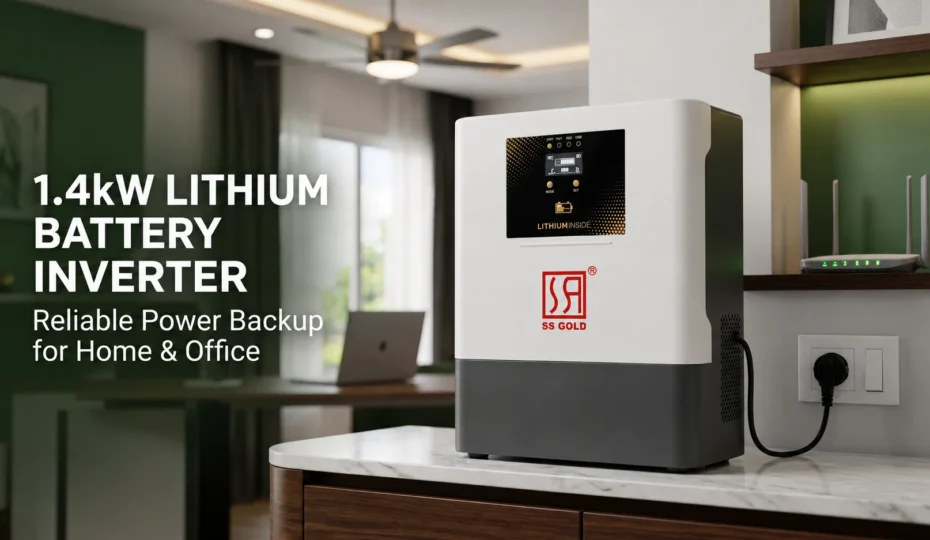
If you are looking for a compact backup solution, the SS GOLD 1.4kW Lithium Battery Inverter is designed to combine inverter functionality with an integrated lithium battery system.
Instead of setting up a separate inverter and external battery, an integrated system can offer a simpler and more convenient installation.
It can be considered for applications such as:
- Homes
- Small offices
- Shops
- Work-from-home setups
- Small commercial spaces
- Essential electrical loads
Key Features
The SS GOLD 1.4kW Lithium Battery Inverter offers features such as:
- 1.4kW power capacity
- Integrated lithium battery
- Long battery life potential
- Compact design
- Low-maintenance battery technology
- Suitable for essential backup requirements
Before purchasing, always check the latest product specifications, battery capacity, warranty, supported load, and installation requirements.
Lithium Battery Inverter vs Lead-Acid Inverter
Both lithium and lead-acid batteries have their own advantages. The right choice depends on your budget, usage, backup requirements, and how long you plan to use the system.
| Feature | Lithium Battery Inverter | Lead-Acid Inverter |
|---|---|---|
| Battery type | Lithium | Lead-acid |
| Maintenance | Generally low | Depends on battery type |
| Size | Usually more compact | Generally larger |
| Battery life | Generally longer | Generally shorter |
| Initial cost | Usually higher | Usually lower |
| Charging | Generally efficient | Depends on battery type |
| Suitable for | Long-term use & convenience | Budget-focused backup |
While lithium systems can cost more initially, it’s worth looking at the overall cost of ownership rather than only the purchase price. Battery replacement, maintenance, and expected lifespan can all affect the actual cost over time.
How to Choose the Right Inverter for Your Home
Buying an inverter without checking your actual power requirements can lead to problems later. Before making a decision, consider these points.
1. Calculate Your Appliance Load
First, make a list of the appliances you want to use during a power cut.
Add their approximate wattage to get an idea of your total load.
2. Choose the Correct Inverter Capacity
Once you know your load, choose an inverter that can comfortably handle it.
It’s better to leave some capacity as a safety margin rather than running the inverter continuously at its maximum limit.
3. Check the Battery Capacity
Don’t confuse inverter capacity with battery capacity.
The inverter capacity, measured in watts or kilowatts, tells you how much power the inverter can deliver.
The battery capacity determines how much energy can be stored and therefore has a major impact on backup time.
4. Think About Battery Technology
If low maintenance, compact design, and longer battery life are important to you, a lithium battery inverter may be worth considering.
5. Check Warranty and Service
An inverter is a long-term investment. So, don’t forget to check the warranty and availability of after-sales service before buying.
6. Pay Attention to Installation
Proper installation is important for both performance and safety.
The wiring, electrical protection, ventilation, and installation location should follow the manufacturer’s recommendations. If required, get the system installed by a qualified professional.
How Long Will a 1.4kW Inverter Provide Backup?
There is no fixed answer to this question.
The backup time depends on several things, including:
- Battery capacity
- Number of appliances connected
- Total power consumption
- Inverter efficiency
- Battery condition
- Operating conditions
For example, if you use the inverter only for a few lights, fans, and a Wi-Fi router, the backup time can be much longer than if you connect several high-power appliances.
So, when comparing inverters, don’t look only at the 1.4kW rating. Also check the battery capacity and your expected backup requirement.
Is a 1.4kW Lithium Battery Inverter a Good Choice?
For people who want reliable backup power without dealing with frequent battery maintenance, a lithium battery inverter can be a practical choice.
A 1.4kW lithium battery inverter can be suitable for everyday essential loads in homes, offices, shops, and small commercial spaces.
It can also be a good option for people who prefer a compact and modern backup power system.
Final Thoughts
Choosing an inverter doesn’t have to be complicated. Start by understanding how much power you actually need, how long you want the backup to last, and what type of battery suits your usage.
If you are looking for a 1.4kW inverter with a lithium battery, an integrated system such as the SS GOLD 1.4kW Lithium Battery Inverter can be worth considering for home and small-office backup needs.
Before making the final decision, compare the battery capacity, inverter output, warranty, installation requirements, and overall cost. This will help you choose a backup system that fits your everyday needs instead of simply buying the highest-capacity inverter available.