Absolutely. I’ll make it sound more natural, conversational, and human-written, while keeping the SEO value, important keywords, headings, facts, and overall structure. I’ll also avoid the repetitive “AI-style” phrases and make the explanations easier for normal readers to follow.
The source content focuses on choosing a portable power station based on capacity, battery chemistry, ports, wattage, charging, portability, solar compatibility, and after-sales support.
How to Choose the Right Portable Power Station: A Simple Buying Guide
A portable power station can be extremely useful when you need electricity away from a regular power outlet. Whether you are going camping, working remotely, travelling, taking photographs outdoors, or preparing for a power cut at home, a power station can keep your important devices running.
But with so many models available, choosing the right one can be confusing.
Should you buy a 300Wh model or a 1000Wh one? Is LiFePO4 better than regular lithium-ion? How much wattage do you actually need? And is solar charging really useful?
Before buying a portable power station, there are a few important things you should check.
What Should You Check Before Buying a Portable Power Station?
Here are the main things to consider:
- Battery capacity in Wh
- Battery chemistry
- Available output ports
- Continuous and peak wattage
- Charging speed
- Weight and portability
- Solar charging support
- Pass-through charging
- Build quality and IP rating
- Warranty, battery cycle life, and after-sales service
The biggest battery is not always the best choice. A camper, photographer, remote worker, food truck owner, and someone looking for emergency home backup can all have very different power requirements.
The easiest way to choose is to first list the devices you want to run, calculate how much power they need, and then select a power station that matches those requirements.
What Is a Portable Power Station?
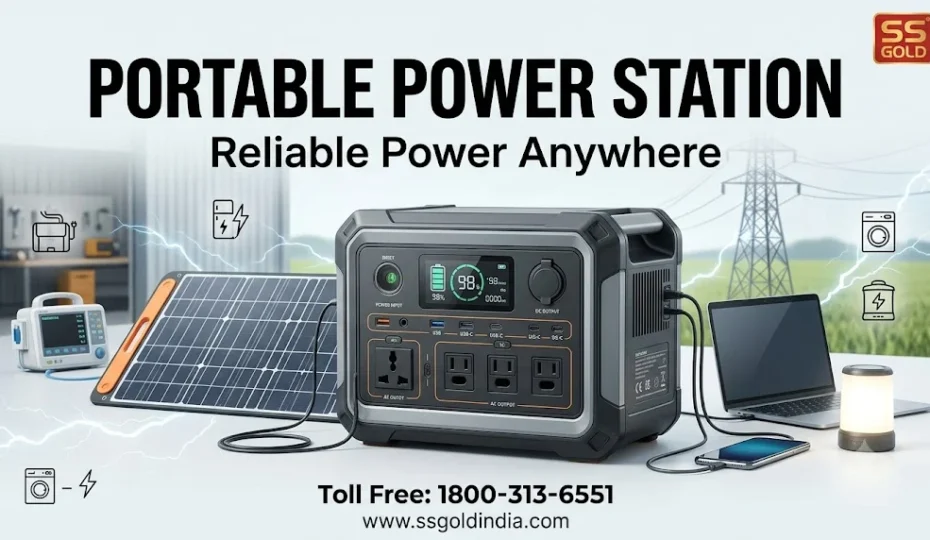
Simply put, a portable power station is a rechargeable battery unit that stores electricity and lets you use it through different output ports.
Depending on the model, you may get AC outlets, USB-A, USB-C, and DC outputs.
You can think of it as a combination of a large rechargeable power bank and an inverter.
Depending on its capacity and output power, a portable power station can be used to charge or run devices such as:
- Smartphones
- Laptops
- Cameras
- Drones
- Wi-Fi routers
- LED lights
- Fans
- Mini refrigerators
- Other compatible small appliances
Unlike a traditional petrol or diesel generator, a portable power station runs on stored battery power, so you don’t need fuel to operate it.
1. How Much Battery Capacity Do You Need?
Battery capacity is one of the first things you should look at when buying a portable power station.
Capacity is generally measured in watt-hours (Wh). It tells you roughly how much energy the battery can store.
For example:
- 300Wh: Suitable for smaller loads
- 600Wh: Good for moderate portable use
- 1000Wh: Suitable for larger backup requirements
- 1500Wh or more: Better for demanding applications
As a general example, a smartphone may need around 15–20Wh, while a laptop may use around 50–70Wh. A refrigerator can require considerably more energy.
How Do You Calculate the Capacity You Need?
A simple way to estimate your requirement is:
Required Capacity = Device Power × Hours of Use
It is also a good idea to keep an additional 20–30% capacity as a buffer because actual power consumption can vary.
Example
Suppose you want to use:
- Laptop: 60W × 5 hours = 300Wh
- Wi-Fi router: 15W × 5 hours = 75Wh
- Light: 10W × 5 hours = 50Wh
That gives you a total requirement of:
425Wh
If we add a 25% buffer, the requirement comes to roughly 530Wh.
In this situation, a 500–600Wh portable power station would make more sense than choosing a smaller 300Wh model.
Tip: Before buying, make a list of all the devices you want to use and estimate their daily power consumption. This will help you avoid buying a power station that is either too small or unnecessarily large.
2. Which Battery Is Better: LiFePO4 or Lithium-Ion?
Most modern portable power stations use lithium-based batteries, but not all lithium batteries are the same.
Two common options are:
- Lithium-ion
- LiFePO4 (Lithium Iron Phosphate)
What Is a LiFePO4 Battery?
LiFePO4 is a type of lithium battery commonly used for energy storage applications.
Compared with some traditional lithium-ion batteries, LiFePO4 models can be heavier and may cost more upfront. However, they can offer a longer cycle life, which can be useful if you plan to charge and discharge the power station regularly.
Which One Should You Choose?
LiFePO4 may be a better option if:
- You use the power station frequently
- You need regular backup at home
- You work outdoors
- You charge and discharge the battery often
- Long battery life is important to you
A lighter lithium-ion model may be suitable if:
- You only use it occasionally
- Weight is an important factor
- You mainly need it for camping or travel
- You want to keep the initial cost lower
Don’t choose a power station simply because the box says “lithium battery.” Check the exact battery chemistry and the manufacturer’s rated cycle life.
3. Which Output Ports Do You Need?
A power station can have a large battery, but that doesn’t help much if you cannot connect your devices to it easily.
So, check the available ports before making a purchase.
AC Outlets
AC outlets are useful for devices that normally plug into a household socket, such as:
- Laptop chargers
- TVs
- Lights
- Some small appliances
USB-A
USB-A ports are still useful for older smartphones, accessories, and other small electronic devices.
USB-C PD
USB-C Power Delivery has become increasingly useful for modern electronics.
It can support compatible:
- Smartphones
- Laptops
- Tablets
- Cameras
- Drones
- Other USB-C devices
DC or Car Socket
The DC output can be useful for compatible 12V equipment, including:
- Camping refrigerators
- Car accessories
- Portable coolers
- Other 12V devices
Instead of simply counting the number of ports, check whether the power station has the right ports for the devices you actually use.
For example, if your laptop and camera both charge through USB-C, having a good USB-C PD output could be much more useful than having several slower USB-A ports.
4. What Is Continuous Wattage and Surge Wattage?
This is one specification that many first-time buyers overlook.
Continuous Wattage
Continuous wattage refers to the amount of power a power station can provide during normal operation.
For example, if a power station has a continuous output of 600W, the total load of the connected devices should normally stay within that limit.
Surge or Peak Wattage
Some appliances need extra power when they first start. This is known as starting or surge power.
Devices such as:
- Refrigerators
- Pumps
- Motors
- Compressors
may require more power for a short period when they start running.
For example, an appliance might normally use 150W but require considerably more power during startup. A power station with only a 200W output could struggle to start that appliance even though its normal running power is below 200W.
So, always check both:
Running wattage + Starting/surge wattage
Then compare those numbers with the power station’s specifications.
5. How Fast Should a Portable Power Station Charge?
Battery capacity tells you how much energy the power station stores. Charging speed tells you how quickly you can get that energy back.
Depending on the model, a portable power station may support charging through:
- AC wall charging
- Solar panels
- Vehicle charging
- USB-C input
Wall charging is generally the quickest option, while solar and vehicle charging can be particularly useful when you are travelling or away from the grid.
Why Does Charging Speed Matter?
Imagine there is a power cut and your power station is almost empty. Electricity comes back for only a short time before another outage happens.
If your power station takes many hours to recharge, you may not have enough backup power when you need it again.
Fast charging can be especially useful for:
- People who experience frequent power cuts
- Photographers
- Remote workers
- Event teams
- Travellers
- Small businesses
Before buying, check the manufacturer’s stated charging time, preferably the time required to charge from 0% to 100% using AC power.
6. How Important Are Weight and Portability?
A larger battery usually means a heavier power station.
While a high-capacity model may provide more backup, it can become difficult to carry if you travel frequently.
Before buying, look at:
- Total weight
- Size
- Handle design
- Carrying case availability
- Wheels on larger models
For photographers and filmmakers, weight can be particularly important because they may already be carrying cameras, lenses, tripods, and other equipment.
For example, imagine two power stations both have a capacity of 500Wh:
Power Station A: 5kg
Power Station B: 8kg
The 5kg model may be more convenient for someone who regularly moves around with their equipment.
If you plan to keep the power station at home, however, the extra weight may not matter as much.
7. Is Solar Charging Worth Having?
If you plan to use your portable power station outdoors or away from the electricity grid, solar charging can be a very useful feature.
It can come in handy for:
- Camping
- Road trips
- Off-grid work
- Outdoor photography
- Power cuts
- Emergency backup
What Is MPPT?
MPPT stands for Maximum Power Point Tracking.
It is a technology that helps optimise the power collected from compatible solar panels.
If you are planning to use solar charging, don’t just check whether the power station supports solar input. You should also make sure the solar panel and power station are compatible.
Check:
- Maximum solar input wattage
- Supported voltage range
- Maximum current
- Connector type
- Recommended solar panel specifications
8. What Is Pass-Through Charging?
Pass-through charging means a power station can charge its own battery while also supplying power to connected devices, provided the manufacturer supports this feature.
This can be useful for:
- Photographers
- Remote workers
- Event teams
- Campers
- Emergency backup
For example, after returning from a photography assignment, you may need to charge your power station, laptop, camera batteries, and drone battery at the same time.
A model with pass-through charging can make this setup more convenient.
However, pass-through charging works differently from one model to another, so always check the manufacturer’s specifications before assuming it is supported.
9. Does Build Quality and IP Rating Matter?
Yes, especially if you plan to use your power station outdoors.
What Does an IP Rating Mean?
IP stands for Ingress Protection. It indicates how well a device is protected against dust and water under specific testing conditions.
For example:
- IP54: Provides basic protection against dust and water splashes
- IP65: Offers stronger protection against dust and water exposure
However, an IP rating does not mean you can leave the power station outside in heavy rain. Always follow the manufacturer’s instructions and protect the unit from unnecessary exposure to water.
IP protection can be particularly useful for:
- Campers
- Outdoor vendors
- Event professionals
- Food truck operators
- Photographers
- People working in dusty environments
10. Why Are Warranty, Cycle Life and After-Sales Service Important?
The battery specifications are important, but what happens after you buy the power station matters too.
Before making your decision, check:
- Manufacturer warranty
- Battery warranty
- Rated cycle life
- Spare parts availability
- Local service support
- Replacement policy
- Customer support
A cheaper power station may not always be the best deal if it has poor service support or a short battery life.
What Is Battery Cycle Life?
Battery cycle life refers to the number of charge and discharge cycles a battery is designed to handle under specified conditions.
If you plan to use your power station frequently, a higher rated cycle life can be an important advantage.
When comparing two similar power stations, look at the overall value:
Price + Battery Cycle Life + Warranty + After-Sales Support
Don’t make your decision based only on the lowest price.
Which Portable Power Station Is Right for You?
Different users have different requirements.
| User | Typical Capacity | Important Features |
|---|---|---|
| Weekend Camper | 300–600Wh | Portability, USB-C, solar charging |
| Photographer / Drone User | 600–1000Wh | LiFePO4, USB-C, manageable weight |
| Remote Worker | 500–1000Wh | Laptop charging, router backup, fast charging |
| Home Backup | 500–1500Wh+ | LiFePO4, pure sine wave, fast charging |
| Food Truck / Exhibitor | 1500Wh+ depending on load | High continuous output, durability, service support |
These are only general ranges. Your actual requirement will depend on the devices you want to run and how long you need to use them.
Frequently Asked Questions
1. What size portable power station is best for camping?
For a basic weekend trip where you mainly need to charge phones, lights, cameras, and other small electronics, a 300–600Wh power station can be a good starting point. If you are travelling for longer or need to run larger devices, you may need a higher-capacity model.
2. Is LiFePO4 better for a portable power station?
LiFePO4 can be a good choice if you plan to use the power station regularly because it can offer a longer cycle life. However, the right choice depends on your budget, portability requirements, and how often you plan to use the battery.
3. Can a portable power station run a mini refrigerator?
It can, provided the power station can handle both the refrigerator’s normal running power and its starting or surge power.
4. Can you charge a portable power station with solar panels?
Yes, if the power station supports solar charging. However, make sure the solar panel’s voltage, current, wattage, and connector are compatible with the power station.
5. Is a portable power station useful during power cuts?
Yes. A correctly sized power station can provide backup for essential devices such as lights, smartphones, laptops, Wi-Fi routers, and compatible fans during a power cut.
6. Which is more important: Wh or W?
Both are important, but they tell you different things.
Wh tells you how much energy the battery can store and gives you an idea of how long it can run your devices.
W tells you how much power the unit can provide at one time.
So, you need enough Wh for your runtime and enough W for your devices.
7. What is the difference between a portable power station and a UPS?
A UPS is mainly designed to provide quick backup when the main electricity supply fails. A portable power station is generally designed for larger energy storage, portability, multiple output options, and flexible charging methods.
Some portable power stations also offer UPS-like functionality, but this depends on the specific model.
8. What should businesses check before buying a power station?
Businesses should pay close attention to continuous output, battery capacity, cycle life, charging speed, warranty, build quality, and after-sales service.
For a business, reliable backup power is particularly important because equipment downtime can directly affect daily operations and revenue.
Final Thoughts
Choosing a portable power station doesn’t have to be complicated.
Start by figuring out what devices you want to run, how much power they need, and how long you need them to run. Then compare battery capacity, output wattage, battery chemistry, charging options, portability, warranty, and service support.
Don’t automatically choose the biggest or most expensive model. The best portable power station is the one that fits your actual power requirements, budget, and usage pattern.