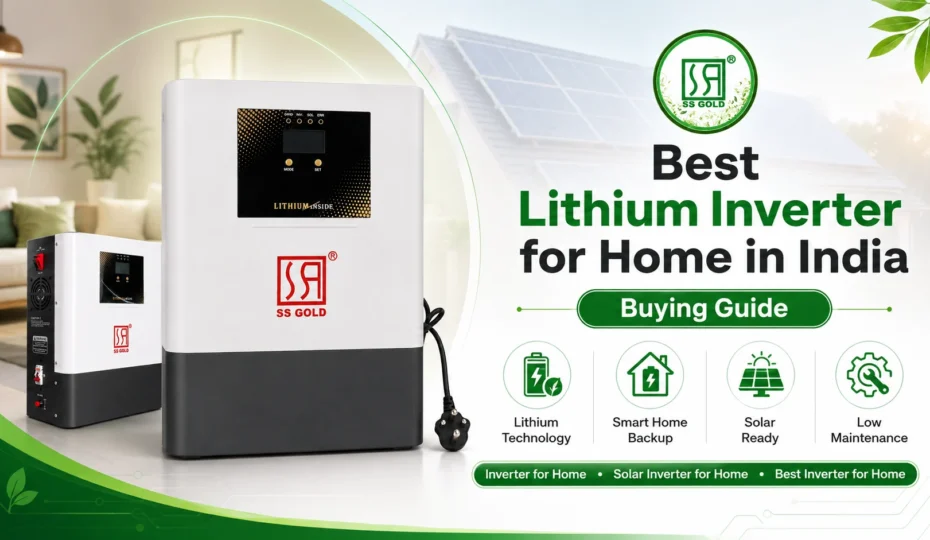
Power cuts, voltage fluctuations and the growing need for uninterrupted electricity have made a reliable inverter for home an important part of many Indian households. At the same time, homeowners are increasingly looking beyond conventional lead-acid batteries toward lithium-based power backup systems.
A lithium inverter for home, especially one that utilizes the LiFePO4 batteries, is a small, maintenance-free, and long-lasting solution. Lithium solutions are also becoming increasingly useful in situations where homeowners wish to incorporate solar energy solutions now or in the future.
However, considering different power ratings, battery capacities, inverter types, and solar options, how does one make an informed choice regarding the best inverter for house?
The following buying guide gives the essential points to keep in mind when buying a lithium inverter in India.
What Is a Lithium Inverter?
A lithium inverter is a type of home backup generator system that utilizes a lithium battery instead of a typical lead-acid battery.
Today’s systems often integrate the inverter, lithium battery, and Battery Management System (BMS) into one single device. This can simplify installation and save space compared to separate units of an inverter and a battery.
The most popular type of lithium battery chemistry used in energy storage is LiFePO4 (Lithium Iron Phosphate) due to its performance characteristics.
Why Consider a Lithium Inverter for Home?
A traditional inverter battery may still be adequate for your needs if you prioritize initial cost above all other factors. However, there are some advantages to going for a lithium-based solution.
Low Maintenance
Old-fashioned flooded batteries may need regular maintenance such as filling up of distilled water from time to time.
But the LiFePO4 battery system will not need much maintenance compared to the flooded battery system since it is more suitable for the modern-day homes.
Longer Battery Life Potential
The cycle life of any battery depends largely on the battery type, degree of discharge, temperatures, charging and use.
In most cases, LiFePO4 batteries have been shown to have increased cycle life compared to old-fashioned lead-acid battery types.
Faster Charging
Generally, lithium-ion batteries have been found to be able to charge faster compared to flooded batteries in combination with a well-designed charger.
This is especially important in situations where electricity comes back temporarily after some power outage period.
Compact Design
The lithium battery technology facilitates the creation of relatively compact integrated systems that incorporate both the battery and the inverter.
In place of a battery placed next to an inverter, it would be possible to use a single compact lithium inverter for home installation.
Solar Compatibility
In case one is thinking of mounting rooftop solar panels, then opting for a solar inverter for home or a lithium inverter with solar compatibility would be an excellent choice.
The solar-compatible system would allow one to use solar energy in charging the battery according to the specifications of the inverter.
How to Choose the Best Lithium Inverter for Home
There is no single inverter capacity that is ideal for every household. The best inverter for home is the one correctly matched to your required appliances, backup duration and future requirements.
Here are the most important specifications to check.
Calculate Your Required Load
Start by identifying which appliances you actually want to operate during a power cut.
For example:
| Appliance | Approx. Power* |
|---|---|
| 4 LED bulbs | 40W |
| 3 ceiling fans | 210W |
| Wi-Fi router | 15W |
| LED TV | 100W |
| Laptop | 65W |
| Estimated total | 430W |
*Actual consumption varies by appliance model.
Don’t select an inverter only on the basis of the number of rooms in your home. Calculate the wattage of the appliances you intend to run simultaneously and keep a reasonable capacity margin.
High-starting-current appliances such as refrigerators, pumps and some motors also need special consideration.
Check Inverter Power Rating
The power rating of an inverter dictates how much load the inverter can carry.
For instance, if there is a house that wishes to run lights, fan, a router and a TV set only, then it needs less power than a house that would want to run a refrigerator, PC, kitchen gadget and any other high power consuming equipment.
One has to be keen on:
Continuous output power rating – Load carried by the inverter.
Surge/Peak capacity – High load carried during start-up of appliances.
This is very critical when selecting inverters for home use.
Check Battery Capacity
Power rating and battery capacity are distinct.
The watt/kilowatt rating specifies the approximate load that the inverter can support.
Wh or kWh rating shows how much energy the battery can hold.
So, a 1,000Wh battery can store sufficient energy for four hours of use at 250W load.
However, the actual runtime will be less owing to efficiency loss from the inverter, operating limits of the battery, and varying appliance load.
An estimate would be:
Runtime ≈ Usable Battery Capacity (Wh) ÷ Load (W)
Hence, in case of high runtime being essential, don’t solely consider the power rating of the inverter but focus on the battery capacity.
Prefer Pure Sine Wave Output
For a modern home, a pure sine wave inverter is generally preferable.
It produces AC power that more closely resembles utility electricity and is suitable for appliances such as:
- TVs
- Fans
- Computers
- Wi-Fi routers
- Refrigerators
- Chargers
- Other sensitive electronics
When searching for the best inverter for home, pure sine wave output should be high on your checklist.
Look for LiFePO4 Battery Technology
Just because an inverter is promoted as being “lithium inverter” doesn’t mean it’s using the same technology for batteries.
It’s necessary to see the specification of the real battery.
LiFePO4 is especially preferable for stationary use (home back-up) since it’s characterized by a good combination of cycle life and thermal stability.
It’s also necessary to look at whether a battery has a Battery Management System (BMS).
The Battery Management System may control many essential parameters, including voltage, current, and temperature.
Consider a Solar Inverter for Home
If you’re going to install solar roof panels, pay closer attention to that.
A solar inverter for home with battery charging support can allow you to use solar energy as part of your backup system.
Check before purchase:
- Max supported solar/PV input
- Solar/MPP/PWM charging type
- PV operating voltage range
- Max solar charging current
- Suggested solar panel capacity
- Lithium battery/BMS compatibility
- Whether the panels are provided or purchased separately
For many users, an MPPT solar charging system can provide more flexible and efficient solar-energy harvesting than a basic PWM controller.
Never plug solar panels in just because the inverter claims to be “solar compatible”. The solar PV configuration has to stay within the PV input limitations of the inverter manufacturer.
Check Charging Speed
Fast charging capability is quite handy in regions where there are constant power outages.
Make sure that you look at the charging current mentioned by the manufacturer, along with the charging time estimate rather than just going by the term “fast charging.“
See if it provides options for charging from:
AC Mains Power, Solar or both
Check Safety Protections
A decent lithium inverter must provide suitable protection for the electrical circuit and battery as well.
This includes protection against:
- Overload
- Short circuit
- Overcharging
- Deep discharging
- Over temperature
- Over voltage
- Under voltage
And other features.
Compare Warranty and After-Sales Support
Long specification sheets alone are not sufficient.
While buying an inverter, one should be mindful of:
- Warranty on inverter
- Warranty on battery
- Comprehensive or prorated nature of warranty
- Availability of installation help
- Service availability in your city
- Replacement policy
- Availability of customer support
While purchasing a complete lithium inverter, it would be best to inquire about the plan regarding replacement of the battery. Serviceability of battery becomes important over time.
Lithium Inverter vs Traditional Lead-Acid Inverter
| Feature | Lithium / LiFePO4 | Lead-Acid |
| Routine maintenance | Low | Higher for flooded batteries |
| Size | Generally compact | Generally bulkier |
| Weight | Generally lighter | Heavier |
| Charging capability | Can support faster charging | Generally slower |
| Cycle-life potential | Higher | Lower |
| Initial investment | Higher | Lower |
| Integrated designs | Common | Less common |
| Solar compatibility | Available | Available |
| Best suited for | Long-term, convenient backup | Budget-focused backup |
A lead-acid system can still make financial sense where the initial budget is limited. Lithium becomes particularly attractive for users who value compact installation, reduced maintenance, higher cycle-life potential and solar integration.
Is a Solar Inverter for Home Worth Considering?
Yes—particularly if you plan to add solar panels in the future.
Even when you do not have rooftop solar panels installed, opting for a solar-friendly lithium inverter means that you are setting yourself up for an upgrade.
A good solar inverter for home might be able to allow your solar power to charge the battery and supply electricity to your household appliances based on your particular system configuration.
Still, solar compatibility will not always translate into an on-grid solar inverter which will be able to export energy to the grid.
Who Should Consider a Lithium Inverter?
A lithium inverter could be ideal for:
City houses and flats: Being compact might be of use if there is little room.
Properties suffering power failures often: Fast recharge capacity and high cycle-life performance could come in handy.
Office at home: Pure sine wave power supply will enable you to keep computers and other office equipment running.
Shops and small businesses: An appropriate-sized system could keep your equipment functioning during the failures.
Solar-powered properties: Lithium-ion battery is good to use with solar energy storage system.
People who do not want to be bothered with maintenance work: There is no need to add water to lithium batteries.
Common Mistakes to Avoid When Buying an Inverter for Home
Do not buy inverter by looking at its VA, watt or kW rating. Battery size decides the runtime.
Do not think that high-rated inverter would offer longer runtime. Inverter with higher power rating along with low-capacity battery will also run for shorter periods.
Do not connect any high-powered loads without considering continuous and surge power ratings of the inverter.
Do not go for any inverter that is compatible with solar power generation without considering its PV compatibility.
Do not overlook the battery chemistry, BMS, warranty and post sales service.
However, more importantly do not buy the best inverter for home based on marketing.
Conclusion
What is the Best Lithium Inverter for Home in India?
A good inverter for home in India would have the correct capacity of the inverter along with the capacity of the battery, pure sine wave inverter, LiFePO4 battery technology, good BMS protection, and after-sales services.
For those looking at solar, a proper choice of a solar inverter for home along with solar compatibility is essential.
Remember the following sequence before making any purchase:
Load calculation → Required backup time → Battery capacity → Inverter capacity → LiFePO4/BMS → Solar compatibility → Warranty and services
Following this sequence will ensure that you choose an inverter for home on the basis of your actual needs.
Frequently Asked Questions (FAQs)
1. What is a lithium inverter for home?
A lithium inverter for home is a power backup system that uses a lithium battery (usually LiFePO4) instead of a traditional lead-acid battery. It provides electricity during power cuts and is known for being compact, low-maintenance, and long-lasting.
2. Is a lithium inverter better than a normal inverter?
Yes, in many cases. A lithium inverter generally offers faster charging, longer cycle life, lower maintenance, and a more compact design compared to traditional lead-acid inverter systems. However, it usually has a higher initial cost.
3. Which is the best inverter for home in India?
The best inverter for home depends on your power requirement, battery capacity, and usage. A pure sine wave lithium inverter with LiFePO4 battery technology is often considered a good choice for modern homes due to efficiency and reliability.
4. How do I choose the right inverter for home?
To choose the right inverter for home, calculate your total load (watts), decide required backup time, check battery capacity (Wh/kWh), and ensure the inverter supports your appliances with proper continuous and surge power ratings.
5. What is the difference between inverter power and battery capacity?
Inverter power (W or kW) tells you how much load it can run, while battery capacity (Wh or kWh) tells you how long it can run that load. Both are important for selecting the right system.
6. Can I use a lithium inverter with solar panels?
Yes, many lithium inverters are compatible with solar panels. A solar inverter for home can charge the battery using solar energy, making the system more energy-efficient and future-ready.
7. What is LiFePO4 battery technology?
LiFePO4 (Lithium Iron Phosphate) is a type of lithium battery known for high safety, long cycle life, and stable performance. It is widely used in modern home energy storage systems.
8. How long does a lithium inverter battery last?
A lithium inverter battery can last several years depending on usage, charging habits, temperature, and quality. LiFePO4 batteries generally offer a higher cycle life compared to traditional lead-acid batteries.
9. Is a pure sine wave inverter necessary for home use?
Yes, a pure sine wave inverter is recommended for home use because it provides clean and stable power suitable for sensitive appliances like TVs, refrigerators, computers, and fans.
10. What appliances can I run on a home inverter?
You can run essential appliances like LED lights, fans, Wi-Fi routers, TVs, laptops, and sometimes refrigerators, depending on the inverter capacity and battery size.
11. What is the difference between a solar inverter and a normal inverter?
A solar inverter for home can use solar panels to charge the battery, while a normal inverter relies only on grid electricity. Solar inverters are more energy-efficient and suitable for long-term savings.
12. Is lithium inverter worth the higher cost?
Yes, for many users it is worth it due to lower maintenance, longer lifespan, faster charging, and better performance. It is especially useful for homes with frequent power cuts or solar integration plans.