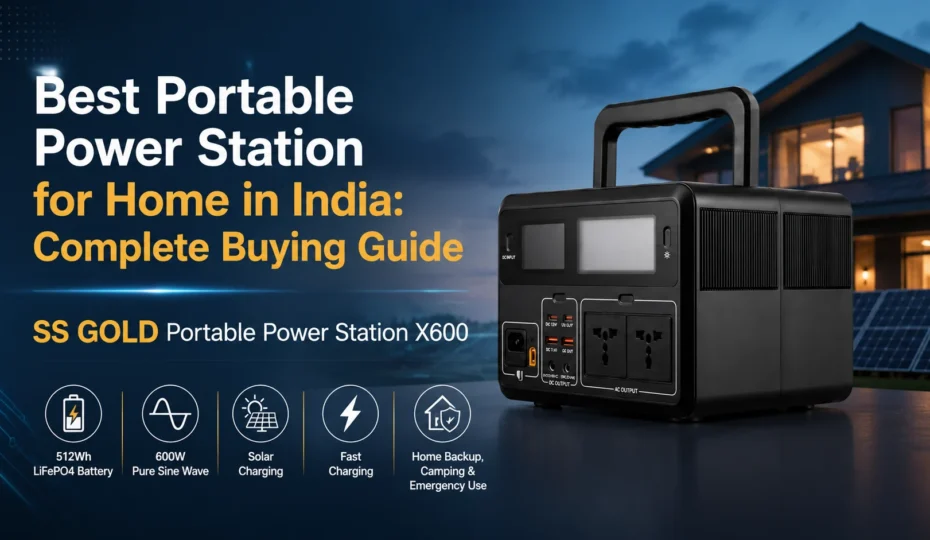
The combination of frequent power outages, telecommuting, outdoor activities, and an increased presence of electronic devices has fueled the need for a flexible alternative source of energy. In addition to regular generators and inverter batteries, there is a solution called the portable power station which is ideal for individuals requiring electricity that does not need fuel, exhaust gases or installation.
But what exactly should you look for when choosing the best portable power station for home in India?
It is important to look at battery capacity, wattage, battery technology, charging time, solar readiness and kinds of output ports. Selecting a power station solely based on the price and battery capacity might end up leaving you with something which does not cater to your needs.
This comprehensive buying guide will give you insights into everything you need to know about the workings of portable power stations and selection thereof.
What Is a Portable Power Station?
Portable power stations are basically a form of a portable rechargeable battery-powered device that acts as an energy store and enables the discharge of stored energy through various means like AC outlets, USB, USB-C and DC outlets.
Unlike traditional fuel-based generators, portable power stations do not need fuel to be charged and do not emit any harmful gases when used.
There are various ways to charge a battery power station depending on the brand, such as:
- AC wall charger
- Solar panels
- Car charger
- USB-C PD charging
- Combination of chargers
Why Are Portable Power Stations Becoming Popular in India?
The reliance on electronics has continued to grow even further. Smartphones, laptops, Wi-Fi routers, cameras, television sets and many other electronic devices have become very important in work and our daily lives.
An ordinary home inverter is definitely one of the best solutions when you require a constant source of energy for powering several different household appliances. But then there are cases where portability becomes essential.
Main benefits of a portable power station for home include:
Portability: You can carry stored energy wherever you want to.
No fuel needed: You don’t have to store any fuel like petrol or diesel.
Low noise level: The battery-powered power stations are much quieter compared to the ordinary fuel generators.
Convenience indoors: Because of the lack of exhaust combustion gases during ordinary battery operations, these are definitely more convenient to use indoors for backup purposes than fuel generators.
Versatility of charging: Charging depends on the particular model but you can charge the power station with AC mains, solar panels, car batteries or USB-C ports.
Versatility of output: One device can be used for charging several different kinds of electronics.
How to Choose the Best Portable Power Station for Home
The best model isn’t necessarily the one with the biggest battery. It should match your expected load, desired runtime and budget.
Here are the specifications you should compare.
Battery Capacity – Wh Matters
The first specification that you will notice on a portable power station is its battery capacity in watt-hours (Wh).
For instance:
- 288Wh
- 500Wh
- 672Wh
- 1000Wh
- 2000Wh
Higher Wh indicates a bigger storage of energy, which can imply longer backup time.
For example, your equipment consumes 100W of energy. In this case, 500Wh of battery can theoretically last for about 5 hours.
In reality, the running time will be shorter due to losses from an inverter, battery management, ambient temperature, and so forth.
The formula is:
Estimated Running Time ≈ Usable Battery Capacity (Wh) ÷ Appliance Consumption (W)
If you need long-term backup time, then focus on Wh.
Understand Output Wattage
Battery Capacity & Output Power are two distinct specifications.
Battery Capacity (Wh) gives an indication of the energy storage.
Output Power (W) is the amount of electrical load that the device can provide at any particular time.
For instance, a 300W Portable Power Station might work well for low-power appliances like:
- Smartphone
- Wi-Fi Router
- LED Lamps
- Laptop Computer
- Camera
- Small Fans
- Others
On the other hand, a 600W, 700W or high-output power station can work with more demanding equipment, as long as the appliance doesn’t exceed the maximum rating of the power station.
When purchasing, make sure you calculate the total wattage of your equipment.
Check Continuous and Surge Power
Don’t only consider the highest wattage indicated by the product.
The portable power station can offer different ratings such as:
- Continuous output: The continuous amount of power that the machine produces.
- Surge/Peak output: The extra power it can produce for some time.
It is especially important to know this difference for appliances with a compressor or motor.
You should always compare the requirements of your appliances with the limitations offered by the producer.
Choose the Right Battery Technology
Battery chemistry is one of the most important considerations when purchasing a portable solar generator or power station.
Modern models may use lithium-ion NMC or LiFePO4 batteries.
Why Consider LiFePO4?
The battery chemistry known as lithium iron phosphate (LiFePO4) has gained popularity in portable power stations owing to its cycle-life capability and thermal properties.
When consumers plan to utilize their batteries often for home backup applications, opting for a LiFePO4 portable power station becomes very appealing since the battery will likely experience several charging and discharging cycles during its operational lifetime.
It is vital to take note of the battery’s cycle-life specification, warranty period, and operating environment instead of considering its battery chemistry alone.
Look for Pure Sine Wave Output
If sensitive electronics are on your list of things to power, it will be wise to go for a pure sine wave portable power station.
A pure sine wave is very similar to grid-supplied electricity and is capable of supporting many compatible electronics.
Examples of such electronic equipment include:
- Computers
- Television sets
- Internet routers
- Digital cameras
- Sound equipment
- Chargers
- Sensitive electronics
This is just one factor you should consider when selecting the best portable power stations.
Check USB-C PD Fast Charging
USB-C has become more and more relevant since many contemporary smartphones, tablets and laptops are compatible with USB-C Power Delivery.
Power station with USB-C PD technology, especially high-power outlet, like 65W and 100W depending on the model, allows to recharge devices right from it, without using their AC adapter.
It is very handy for travellers, photographers and people working remotely.
Before buying, it is worth to consider the number of USB-C outlets and their power individually.
Consider Solar Charging Support
Solar compatibility is one of the main benefits of modern portable power stations.
Solar generator for home is usually a combination of a portable power station and compatible solar panels.
In cases of prolonged power outages, camping, or working outdoors, solar energy may become an additional source of power supply.
But you should not attach any solar panels.
Make sure to know your power station’s requirements regarding:
- Solar input wattage
- Input voltage range
- Max current
- Connector type
- Configuration of recommended solar panels
- MPPT compatibility if any
Electrical characteristics of the solar panels should stay within the limits of input characteristics of the power station.
Check Charging Time
Consider the case of a power station offering several hours of backup but needing a whole day to recharge itself. This would not be an effective solution in areas experiencing frequent power shortages.
This explains the importance of charging speeds.
The latest power stations offer fast AC charging capability and could even have the ability to charge via USB-C and even solar energy.
When choosing power stations, always consider the manufacturer’s 0-100% charging time.
Check Available Ports
Consider the exact connections you want to make.
A highly flexible portable power station for domestic purposes might consist of a mixture of:
- AC sockets
- USB-A ports
- USB-C PD ports
- 12V DC socket
- Car socket
- DC sockets
Multiple output ports are beneficial; however, the overall output capacity remains the same.
Just because your power station has six different output ports does not imply that you can connect six high power-consuming devices to it at once.
Consider Weight and Portability
The 300Wh portable power station and the 2000Wh power station have entirely different applications.
Higher capacity of batteries typically means more weight.
Should you be using the power station primarily for camping or traveling with it from one place to another, then weight would be an essential factor to take into consideration.
When it comes to extended backup at home when moving the device is not expected often, capacity might be more critical than minimizing the weight of the product.
Make sure that there is a good handle included.
What Size Portable Power Station Do You Need?
A simple way to choose capacity is to first list the devices you want to operate.
| Device | Typical Approx. Power* |
|---|---|
| Smartphone charger | 10–30W |
| Wi-Fi router | 10–20W |
| LED light | 5–15W |
| Laptop | 45–100W |
| Fan | 50–80W |
| LED TV | 60–150W |
| Mini fridge | 50–150W+ |
*The actual power usage is quite varied from one gadget to another.
For phone, laptop, and camera charging, the small 300W power station would be enough.
For more gadgets, TVs, fans, and longer battery backup times, you can consider 600W, 700W, or higher wattage output power stations with higher battery capacity.
For heavy-duty home backup needs, you can go for a 1000W and above capacity power station with much higher Wh rating.
Always calculate your needs beforehand.
Portable Power Station vs Traditional Generator
| Feature | Portable Power Station | Fuel Generator |
| Fuel | Electricity / supported solar | Petrol/Diesel |
| Operating noise | Low | Higher |
| Exhaust emissions during operation | None from battery | Yes |
| Indoor practicality | Better | Fuel generators must be operated outdoors according to safety instructions |
| Maintenance | Generally low | Regular engine maintenance |
| Portability | Usually convenient | Varies |
| Solar charging | Available on compatible models | Generally not integrated |
| High-power continuous operation | Limited by battery/inverter | Often better for large loads |
| Refuelling/recharging | Requires charging time | Fast with available fuel |
The portable power station is not necessarily a substitute for all generators.
It could still be true that fuel-based generators will be better for higher capacities and extremely long run times when fuel availability is not an issue.
When dealing with electronics, backups on shorter to medium-term basis, indoor and portable application, the battery power station could work well enough.
Portable Power Station vs Home Inverter
These products also solve slightly different problems.
A traditional inverter for home is usually installed permanently and connected to selected household circuits or appliances.
A portable power station is designed to be movable and normally powers devices connected directly to its outputs.
Choose a home inverter when you need permanent whole-room or multi-appliance backup.
Choose a portable power station when you value portability, plug-and-play operation, travel use or flexible emergency power.
Some households may even benefit from having both.
Is a Portable Power Station Useful for Camping?
Yes. Camping is among the top uses for portable power stations.
Based on its capacity and output, a power station can be used to either run or charge the following items:
- Camping lamps
- Smart phones
- Cameras
- Drones
- Laptops
- Portable fans
- Coolers (those that work with a battery power station)
- GPS devices
Combining the power station with portable solar panels makes it even more helpful during long camping trips.
A battery power station is also much quieter because it does not have to run an internal combustion engine.
Can a Portable Power Station Be Used for Emergency Backup?
Yes.
Keeping a charged portable power generator available can be useful during unexpected power failures.
For example, it can help maintain communication and basic connectivity by powering phones, laptops, lights and Wi-Fi equipment.
The key is choosing enough battery capacity for the equipment you consider essential.
Common Mistakes to Avoid When Buying a Portable Power Station
Purchase According to Wattage Alone
A 1000 watt power station does not necessarily provide longer backup than a 700 watt one. Check battery capacity in Wh too.
Igoring Surge Rating
Starting motors consume more electricity than running ones.
Igoring Type of Battery Used
Battery type and rated cycles can make a huge difference in the total ownership.
Considering That All Models Can Use Solar Panels
Check solar panel input specs before purchase.
Buying Battery With Insufficient Backup Time
Determine how many hours of power you need and choose accordingly.
Igoring Charging Speed
Charging speed is sometimes as important as battery capacity.
Igoring Warranty & Service Availability
Check warranty terms and availability of after-sales service in India.
Who Should Buy a Portable Power Station?
A portable power station can be a particularly useful investment for:
Home users who want backup for essential electronics during power cuts.
Remote workers who need to keep laptops and Wi-Fi equipment running.
Campers and travellers who need portable electricity away from wall sockets.
Photographers and creators who regularly charge cameras, lights, laptops or drones outdoors.
Small offices and shops that need emergency backup for essential electronics.
Emergency-preparedness users who want stored power available during unexpected outages.
Conclusion
What is the Best Portable Power Station for Home in India?
There is no best portable power station for home in India that fits everyone.
The correct choice will depend on answering three primary questions:
What is the power of your devices?
What are the required hours of backup?
Where do you want to use the power station?
For general devices and travels, a small 300W portable power station might suffice. On the other hand, for backup at home and multiple appliances, it is necessary to have a power station that can provide higher power and considerably more energy.
For long-term utilization, having a LiFePO4 battery, pure sine wave output, quick charging, and USB-C PD and solar charging capabilities can add substantial value.
In advance of buying a device, follow the below easy steps:
Determine load → estimate runtime → determine Wh capacity → check output wattage → check surge rating → check battery type → check charging capabilities → check ports.
And in doing so, you will make your decision based on your real-life needs and not just choose the most powerful or cheapest model.
Frequently Asked Questions (FAQs)
1. What is a portable power station used for?
A portable power station is used to store electricity and power devices like smartphones, laptops, Wi-Fi routers, lights, fans, cameras, and other small to medium electronic appliances during power cuts, travel, or outdoor activities.
2. Which is the best portable power station for home use in India?
The best portable power station depends on your needs. For basic use like charging phones and running Wi-Fi routers, a 300W–500W model is enough. For multiple devices or longer backup, 600W–1000W or higher capacity models with larger Wh ratings are better.
3. How long does a portable power station last on a single charge?
Backup time depends on battery capacity (Wh) and the power consumption of your devices. For example, a 500Wh power station can run a 100W device for around 4–5 hours in real-world conditions.
4. Can a portable power station run a refrigerator or TV?
Yes, but it depends on the wattage. LED TVs can usually run on 300W–700W models. Small refrigerators may require higher-capacity power stations (1000W+ with sufficient surge power).
5. What is the difference between Wh and W in a power station?
- Wh (Watt-hour): Shows battery capacity (how much energy is stored)
- W (Watt): Shows output power (how much load it can handle at once)
Both are important when choosing a power station.
6. Can I charge a portable power station with solar panels?
Yes, many models support solar charging. However, you must use compatible solar panels that match the voltage, current, and input limits specified by the manufacturer.
7. How long does it take to charge a portable power station?
Charging time varies by model. Some small units may take 3–5 hours, while larger ones can take 6–10+ hours. Fast-charging models can reduce this time significantly.
8. Is a portable power station better than a home inverter?
A portable power station is better for mobility, travel, and small device backup. A home inverter is better for permanent installation and running multiple household appliances for long durations.
9. Can I use a portable power station indoors safely?
Yes, portable power stations are safe for indoor use because they do not produce fumes or exhaust gases like fuel generators. However, always follow manufacturer safety guidelines.
10. What devices can I charge with a portable power station?
You can charge:
- Smartphones
- Laptops
- Tablets
- Wi-Fi routers
- LED lights
- Cameras
- Small fans
- Drones and other USB/AC-compatible devices
11. What is LiFePO4 battery in a power station?
LiFePO4 (Lithium Iron Phosphate) is a battery type known for longer lifespan, better safety, and more charge cycles compared to standard lithium-ion batteries.
12. Do portable power stations make noise?
No, most portable power stations operate silently because they use battery power instead of fuel engines.
13. Can a portable power station replace a generator?
Not completely. Portable power stations are ideal for small to medium loads and indoor use, while generators are better for heavy-duty and long-duration high-power needs.
14. What size portable power station do I need for home use?
- 300W–500W: Basic devices (phones, lights, Wi-Fi)
- 600W–1000W: Multiple devices, TV, fans
- 1000W+: Heavy usage and longer backup needs
15. Is it worth buying a portable power station in India?
Yes, especially if you experience frequent power cuts, work remotely, travel often, or need a clean, quiet, and portable backup power solution for essential electronics.