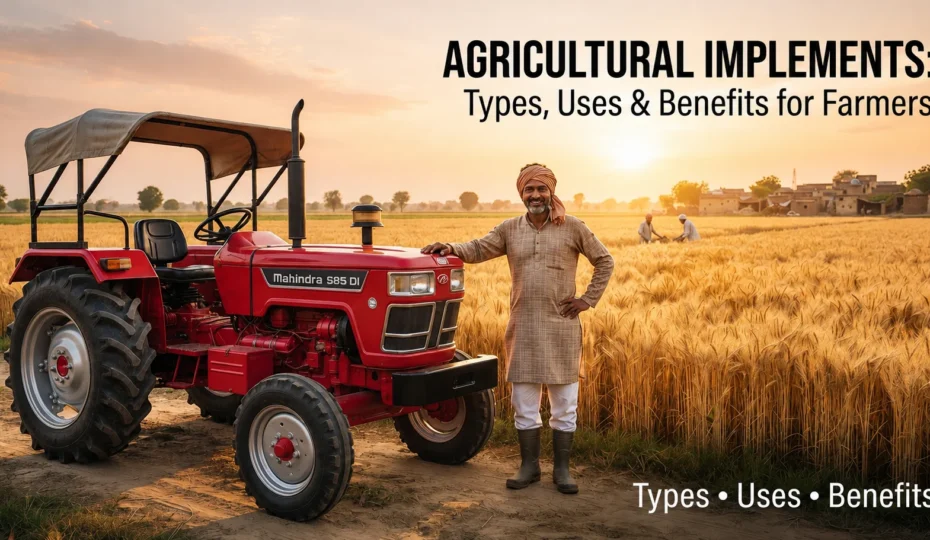
Agricultural Implements: Types, Uses and Benefits for Indian Farmers
Farming is not a one-step job. A farmer has to prepare the soil, sow seeds, remove weeds, apply fertilizers, protect the crop and finally harvest it. Doing all these activities manually can take a lot of time and physical effort.
This is where agricultural implements become useful.
Agricultural implements are farming tools and attachments that help farmers carry out different farm activities more easily. Some are simple tools that can be operated by hand, while others are designed to work with tractors or other machines.
From a traditional plough to a modern seed drill, the right agricultural implement can help save time, reduce manual work and make everyday farming more manageable.
In this guide, we will look at the different types of agricultural implements, their uses and the things farmers should consider before buying them.
What Are Agricultural Implements?
Agricultural implements are tools or attachments used to perform different farming operations.
Depending on the type of work, they can be used for:
- Preparing the soil
- Ploughing
- Tilling
- Sowing seeds
- Planting
- Removing weeds
- Applying fertilizers
- Spraying crops
- Harvesting
- Moving farm materials
Some agricultural implements are small and manually operated, while others are attached to tractors.
The right implement depends on your farm size, crop, soil condition and the type of work you need to do.
Different Types of Agricultural Implements
There are many agricultural implements available today, and each one has a different purpose. Let’s look at some of the commonly used options.
1. Tillage Implements
Before seeds are planted, the soil needs to be prepared properly. Tillage implements help loosen the soil, break large clumps and make the field ready for sowing.
Common tillage implements include:
- Plough
- Cultivator
- Rotavator
- Disc harrow
- Subsoiler
- Land leveler
Good soil preparation gives the crop a better environment to grow and makes the next stages of farming easier.
2. Plough
The plough is one of the oldest farming tools, but it is still widely used today.
Its main purpose is to turn and loosen the soil before planting. Tractor-operated ploughs can help farmers prepare larger areas in much less time compared with traditional manual methods.
What Is a Plough Used For?
A plough can be used for:
- Initial soil preparation
- Turning the soil
- Breaking compacted soil
- Preparing the field before cultivation
If your farm has hard or compacted soil, selecting the right plough can make the preparation process much easier.
3. Cultivator
A cultivator is generally used after the field has been ploughed.
It helps loosen the soil and, depending on its design, can also be useful for controlling weeds between crop rows.
Cultivators are available in different sizes, so it is important to choose one that matches your tractor and field conditions.
4. Rotavator
A rotavator is a popular agricultural implement used for preparing the soil. It has rotating blades that break up and mix the soil.
Farmers commonly use rotavators to:
- Break soil clumps
- Loosen the soil
- Prepare the seedbed
- Mix crop residue into the soil
- Reduce the time required for field preparation
For farmers who need to prepare their fields quickly, a suitable rotavator can be a useful addition to their farm equipment.
5. Harrow
A harrow is usually used after ploughing.
Its job is to break the remaining soil clumps and help create a more even surface. Disc harrows are commonly used with tractors and are available in different sizes.
The right harrow depends mainly on the soil condition and the type of field preparation you need.
6. Seed Drill
Once the soil is ready, the next step is sowing.
A seed drill helps place seeds at a more consistent depth and spacing. This can make the sowing process more organised and reduce the amount of manual work involved.
Benefits of a Seed Drill
- Faster sowing
- Better seed placement
- More consistent spacing
- Reduced manual labour
- Potentially less seed wastage
The seed drill should be adjusted according to the crop and the required seed depth and spacing.
7. Planter
A planter is designed to plant specific types of crops and seeds.
It places seeds at a controlled distance from each other, which can be useful for crops that require a particular row spacing.
The type of planter you need will depend on the crop you are growing and your planting method.
8. Weeding Implements
Weeds are a common problem in farming. They compete with crops for water, nutrients, sunlight and space.
If weeds are not controlled properly, they can affect crop growth.
Some commonly used weeding implements include:
- Hand hoes
- Manual weeders
- Power weeders
- Inter-row cultivators
- Tractor-operated weeders
The right option depends on your crop, field size and the distance between crop rows.
9. Power Weeder
A power weeder can be particularly useful for small farms, vegetable fields and areas where crop rows are narrow.
It can help remove weeds and loosen the soil without requiring a large tractor.
For farmers working in places where bigger agricultural machines are difficult to use, a power weeder can be a practical option.
10. Agricultural Sprayer
Agricultural sprayers are used to apply liquid products to crops. Depending on the type of sprayer, they can be used for pesticides, fungicides and liquid fertilizers.
Some common types include:
- Hand sprayers
- Battery-operated sprayers
- Knapsack sprayers
- Tractor-mounted sprayers
- Boom sprayers
Using the right sprayer can make crop treatment faster and more convenient.
When using agricultural chemicals, always follow the product instructions and use the recommended protective equipment.
11. Fertilizer Applicator
Applying fertilizer evenly over a large field can be difficult when done manually.
A fertilizer applicator can make the job easier and help distribute fertilizer more consistently when the equipment is properly adjusted.
The right fertilizer applicator depends on the crop, type of fertilizer and the way it needs to be applied.
12. Harvesting Implements
Harvesting is one of the busiest times for a farmer. In many cases, the crop needs to be harvested within a limited period, especially when weather conditions can affect the produce.
Reapers and crop-specific harvesting machines can help complete the work faster and reduce dependence on manual labour.
The right harvesting equipment depends on the crop and the size of the farm.
13. Thresher
Harvesting the crop is not always the end of the process. For many crops, the grain or seed still needs to be separated from the plant.
This is where a thresher can help.
A thresher makes the process faster and is particularly useful for farmers handling large quantities of crops.
14. Agricultural Trailer
An agricultural trailer is mainly used for transportation around the farm.
It can carry:
- Harvested crops
- Fertilizers
- Seeds
- Farming tools
- Farm materials
- Other agricultural goods
When connected to a suitable tractor, a trailer can make transportation easier and reduce the need to carry heavy materials manually.
Benefits of Using Agricultural Implements
The right agricultural equipment can make a noticeable difference in everyday farming.
Saves Time
Many farming activities can be completed much faster with suitable equipment than through manual methods.
This can be especially helpful during busy periods such as sowing and harvesting.
Reduces Manual Labour
Finding enough farm workers can sometimes be difficult, particularly during peak farming seasons.
Agricultural implements can reduce the amount of manual work needed for several farm activities.
Reduces Physical Effort
Farming can involve a lot of digging, lifting and repetitive work.
Using suitable equipment can reduce the physical workload for both farmers and workers.
Helps Finish Work on Time
Farming activities often need to be completed at the right time. A delay in sowing, weeding or harvesting can affect the overall farming process.
Using the right implement can help farmers complete important jobs within the required time.
Improves Farm Efficiency
When the right equipment is used for the right task, farmers can make better use of their time, labour and available resources.
Available for Different Farm Sizes
Agricultural implements come in different sizes and designs. So, farmers can select equipment according to the size of their farm and their actual requirements.
Agricultural Implements vs Agricultural Machinery
The terms agricultural implements and agricultural machinery are sometimes used interchangeably, but there is a difference.
Agricultural machinery usually refers to powered machines such as:
- Tractors
- Power tillers
- Harvesters
Agricultural implements are generally tools or attachments used to perform a particular farming operation.
For example:
Tractor = Agricultural machinery
Plough = Agricultural implement
Cultivator = Agricultural implement
Rotavator = Agricultural implement
In simple terms, the tractor supplies the power, while the implement performs the specific farm operation.
Both work together as an important part of modern farm mechanization.
How to Choose the Right Agricultural Implement
Buying agricultural equipment is an investment, so farmers should consider their actual requirements before making a purchase.
1. Consider Your Farm Size
You may not need a large, high-capacity machine for a small farm. Choose equipment that is practical for the area you cultivate.
2. Consider Your Crop
Different crops need different types of equipment.
For example, equipment suitable for rice or wheat may not be the best choice for vegetables or horticultural crops.
3. Check Tractor Compatibility
If you are buying a tractor-operated implement, check whether your tractor has enough power and whether the implement is compatible with its specifications.
4. Consider Your Soil
Soil type and field conditions can affect the performance of implements such as ploughs, cultivators and other tillage equipment.
5. Check Service and Spare Parts
Before buying, find out whether spare parts and servicing are available in your area.
Easy access to service support can save you considerable time if the equipment needs repair.
6. Look at the Total Cost
Don’t judge equipment only by its purchase price.
Also consider:
- Maintenance
- Fuel consumption
- Repairs
- Spare parts
- Servicing
- Expected working life
Sometimes, spending a little more on reliable equipment can be more beneficial in the long run.
Why Agricultural Implements Are Important for Indian Farmers
Indian farming is very diverse. There are small farms, large farms, different soil types and many different crops. Because of this, the same agricultural equipment will not be suitable for every farmer.
For example, a small farmer may find a compact power weeder more useful, while a large farm may need tractor-operated implements or high-capacity harvesting equipment.
Modern farming is not about buying the biggest or most expensive machine.
It is about choosing equipment that actually solves your farming problem.
If labour availability is making sowing difficult, a seed drill could be useful. If weed control is taking too much time, a power weeder may be a better investment.
The best agricultural implement is the one that suits your farm and helps you complete your work more efficiently.
Final Thoughts
Agricultural implements have become an important part of modern farming in India.
From ploughs and cultivators to rotavators, seed drills, weeders, sprayers and harvesting equipment, there are tools available for almost every major farming activity.
However, there is no single implement that is perfect for every farmer.
Before buying any equipment, consider your farm size, crop, soil condition, tractor compatibility, labour availability and budget.
Choosing the right agricultural implement can save valuable time, reduce physical effort and make everyday farming easier.
As Indian agriculture continues to adopt modern technology, practical and affordable agricultural implements will remain an important part of efficient farming.
Frequently Asked Questions
1. What are agricultural implements?
Agricultural implements are tools or attachments used for different farming activities such as ploughing, tilling, sowing, weeding, spraying and harvesting.
2. What are the most commonly used agricultural implements?
Some commonly used agricultural implements include ploughs, cultivators, rotavators, harrows, seed drills, planters, power weeders, sprayers, threshers and agricultural trailers.
3. What is a rotavator used for?
A rotavator is mainly used for preparing the soil. Its rotating blades break soil clumps, loosen the soil and mix crop residue, helping prepare the field for sowing.
4. What is a seed drill used for?
A seed drill helps sow seeds at a more consistent depth and spacing. It can make the sowing process faster and reduce manual labour.
5. How does a cultivator help farmers?
A cultivator helps loosen the soil after ploughing. Depending on its design, it can also help control weeds between crop rows.
6. What is a power weeder?
A power weeder is a compact machine mainly used for weed control and soil loosening. It can be particularly useful for small farms, vegetable fields and narrow crop rows.
7. What are the main benefits of agricultural implements?
Agricultural implements can save time, reduce manual labour and physical effort, and help farmers complete different farming activities more efficiently.
8. How can I choose the right agricultural implement?
Consider your farm size, crop type, soil condition, tractor compatibility, labour availability, maintenance requirements and budget before buying.
9. Are agricultural implements useful for small farms?
Yes. Many implements are available in compact sizes. Depending on the farming requirement, equipment such as power weeders and smaller cultivation implements can be useful for small farms.
10. What is the difference between agricultural machinery and agricultural implements?
Agricultural machinery generally includes powered machines such as tractors, power tillers and harvesters. Agricultural implements are tools or attachments such as ploughs, cultivators and rotavators that perform specific farming tasks.
11. Can agricultural implements be used with tractors?
Yes. Many agricultural implements are designed to be attached to tractors. However, always check the implement’s compatibility with your tractor before purchasing.
12. Why are agricultural implements important in modern farming?
Agricultural implements help farmers complete different farm activities with less time and physical effort. They can also help manage labour shortages and improve overall farm efficiency.