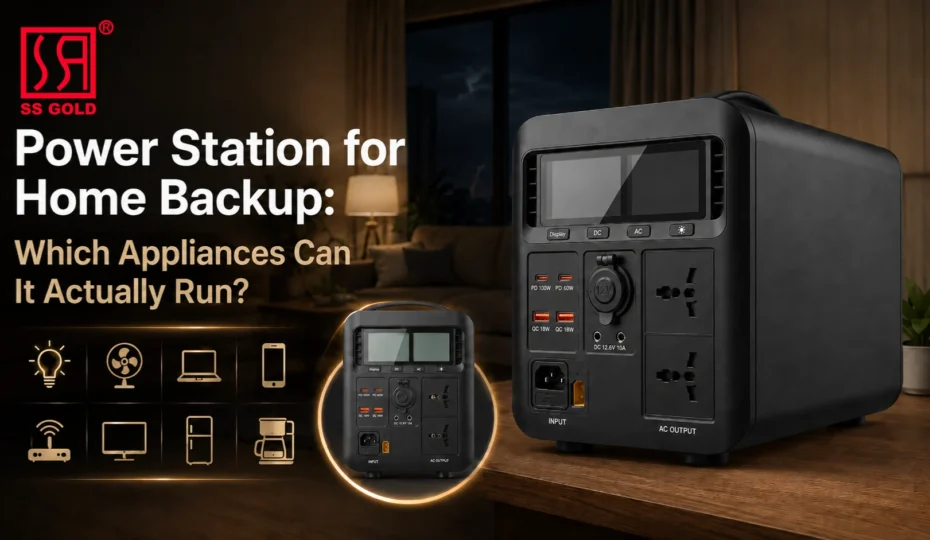
A blackout may affect everything from business meetings and internet access to lighting and basic home appliances. That’s why a portable power station as an alternative energy source becomes a necessity nowadays for those who need quiet, green and portable power during emergencies.
However, there is a crucial point to consider before purchasing a portable power station:
What appliances will your portable power station be able to operate?
Can it supply power to a fridge? Can it handle fans, Wi-Fi routers, computers, TVs, kitchen equipment?
This all depends on the capacity and the output power of the station itself, measured in watt-hours (Wh) and watts (W).
What Is a Portable Power Station?
The portable power station is basically a rechargeable battery device with multiple outputs like AC outlets, USB ports, and DC outputs.
These devices can typically be charged via:
- Wall outlet electrical power supply
- Solar panel charging
- Car charging
- Charging from a USB-C port on compatible devices
After charging the device, you can attach any compatible device to the power station.
Unlike the traditional stationary inverter, the portable power station is portable and independent and can therefore be used both at home and outdoors.
Understanding Watts and Watt-Hours
However, before deciding on what appliances you will be able to operate, you need to know about the following three concepts.
Watts (W)
This concept refers to the level of power consumption that is required for operating the appliance.
For instance, if your portable power station has a continuous power output of 500W, then usually the level of the total connected load should not exceed the supported level.
Watt Hours (Wh)
Watt hours refer to the level of battery power supply and allow you to estimate how long the appliances will work.
Higher Wh level means higher backup power time of your appliances.
Surge Watts
Some motor or compressor-powered appliances might need extra power at the start-up time.
As it was mentioned above, the source states that the starting surge of 400-450W could be needed when starting a 150W refrigerator.
Which Home Appliances Can a Portable Power Station Run?
Here are approximate figures from the supplied guide:
| Appliance | Approx. Running Power |
|---|---|
| Smartphone charging | 10–20W |
| Wi-Fi router | 10–15W |
| LED light | 8–10W |
| Laptop | 50–65W |
| Ceiling fan | 60–75W |
| Mini refrigerator | 100–150W |
| Full-size refrigerator | 150–400W |
| CPAP machine | 30–60W |
| Laptop + monitor | 100–120W |
| Microwave | 700–1200W |
| Induction cooktop | 1200–1800W |
Actual consumption varies considerably between appliance models.
Let’s look at some of the most common appliances individually.
Can a Power Station Charge Smartphones?
Yes, The smartphone is one of the easiest electronic gadgets that can be powered using the portable power station due to its low demand for energy.
In cases where the portable power station produces USB-C PD and USB-A ports, one can also charge his/her phone without occupying the AC port.
The portable power station becomes very vital during prolonged blackouts when there is need for communication.
Can It Run a Wi-Fi Router?
Yes, a Wi-Fi router consumes comparatively less power. The provided manual suggests that an average router runs around 10 to 15W.
When working from home, running both the router and the laptop will help you keep working even if there is a power failure.
But do keep in mind that your internet connection will continue only as long as the infrastructure of your ISP is functioning.
Can It Run LED Lights?
Yes, LED lights consume less power, making them a good choice for being run on a power station.
In case of power failure during the night time, the power station will help you light up your room.
Can a Portable Power Station Run a Laptop?
Yes, the included guide estimates the energy use of a laptop to be roughly 50-65W but may vary depending on the laptop being used.
These power stations are perfect for:
- Remote working professionals
- Students
- Freelancers
- Content creators
- Photographers
- Travellers
Higher power USB-C PD outputs power stations will be able to charge compatible laptops.
Can a Power Station Run a Fan?
Yes, if the fan has lower watts than what the maximum output of the power station is.
The included guide estimates a ceiling fan at about 60-75W.
Thus, having a combination like a fan, a Wi-Fi router, and some LED lights becomes an effective emergency backup solution.
Can a Portable Power Station Run a Refrigerator?
Yes, but here you have to be very careful about surge power.
Your fridge has a compressor that will need much more electrical power to start than during its regular use.
As stated by your source, the mini/portable fridge may use 100–150 watts, and a regular fridge may consume 150–400 watts, with higher start-up consumption.
This is why you shouldn’t take into account only the running power of the fridge while choosing the power station.
Consider both:
Continuous and surge/peak output power.
Can It Run a Television?
Many portable power stations can power an LED television, provided that its power consumption is within the power station’s output power.
If you want to create an entertainment back-up system, you may use:
TV + Wi-Fi router + LED light
Find the total consumption first.
Can a Power Station Run a Microwave?
In some cases, it is possible if a power station has higher power capacity.
According to your provided guideline, the consumption of a microwave is estimated at approximately 700 – 1200W.
So, a smaller power station with power capacity 300W and 500W will not work for this purpose.
In order to run a microwave, you should get a power station with much higher power capacity that can cover its requirements.
Can It Run an Induction Cooktop?
Possibly, but only with a high power capacity power station.
According to your supplied material, induction cooktops may require up to 1200 -1800W.
This device needs high inverter power capacity and big battery capacity as well.
In case, you just need an emergency backup, it could be better to use power for lights, fans, communication, internet devices instead of high-power cooking.
What About ACs, Geysers and Other Heavy Appliances?
Small portable power stations generally aren’t designed for heavy appliances such as:
- Air conditioners
- Water heaters/geysers
- Large induction cooktops
- Heavy pumps
- High-power heaters
- Some washing machines
The supplied guide notes that these types of loads generally require a 2000Wh+ class system with sufficiently high output and surge capability, and even then runtime may be limited.
For regular whole-home backup involving heavy appliances, a properly sized fixed inverter, home battery system or generator may be more appropriate.
How to Calculate the Power Station Size You Need
It is one of the crucial steps before buying.
Initially, the appliances that you want to run must be identified.
Let us say that the devices are as follows:
- Fan: 70W
- Lights: 30W
- Router: 15W
Thus, total load = 115W
Now, if you want to run them for 6 hours,
115W × 6 hours = 690Wh
As per the recommendation from the source, 20-30% buffer must be considered, so that makes it somewhere around 850-900Wh of capacity requirement.
There can be variations in practical run-time due to inverter inefficiencies and other factors.
What Size Power Station Is Best for Home Backup?
Do not just pick up based on pricing; instead, size up the battery in relation to how you plan to use it.
300–500Wh
Best used for smaller demands such as phone charging, laptop, routers, camera, and LED lighting among others.
500–1000Wh
A more versatile one for basic home backup, including a variety of items such as lights, fans, router, laptop, and other compatible appliances.
Your guide has indicated that 500–1000Wh can help out during 4–6 hours of outage of necessary appliances.
1000–2000Wh
More suitable for people having longer backup needs and/or using multiple appliances.
2000Wh+
Ideal choice for heavy backup needs; however, wattage and surge ratings of the appliances need to be considered.
A larger battery is not necessarily able to operate every appliance; maximum output wattage is a limiting factor.
Why LiFePO4 Battery Technology Matters
Chemistry of the battery is another crucial purchasing factor.
As per the provided guide, one should pay attention to LiFePO4 batteries because of their increased lifespan and cycle life.
In the case of home backup power that will be used and charged on a regular basis, the cycle life of the battery can make a huge difference.
Among other things, consider the following while making comparisons between different products:
- Battery chemistry
- Number of charging cycles
- Battery management system (BMS)
- Battery warranty
- Charging temperature range
- Recommendations of the manufacturer
Should You Choose Solar Charging?
The use of solar charging will make the power station much more flexible.
In case the device can support the appropriate solar panels, you will have an opportunity to charge the device even during long-term outages or when camping without access to the grid.
This feature is especially helpful in the following situations:
- Power outages
- Camping
- Working in remote areas
- Road trips
- Outdoor parties
- Preparation for emergency situations
It is important to know the characteristics of the solar input of the device before using solar panels.
Power Station vs Inverter vs Generator
Each has a different ideal application.
| Feature | Power Station | Inverter | Generator |
|---|---|---|---|
| Portability | High | Usually low | Medium |
| Noise | Very low | Low | High |
| Fuel required | No | No | Yes |
| Routine maintenance | Generally low | Depends on battery | Higher |
| Indoor convenience | High | High | Low |
| Best use | Portable/essential backup | Fixed home backup | Long-duration/high loads |
The supplied guide similarly positions portable power stations for short-to-medium-duration portable needs, inverters for fixed home backup, and generators for higher-power, longer-duration applications.
What to Check Before Buying a Portable Power Station
Before making your final decision, compare:
- Battery capacity in Wh
- Continuous output in W
- Surge/peak output
- LiFePO4 or other battery chemistry
- Pure sine wave AC output
- USB-C PD support
- AC and DC output options
- Charging speed
- Solar charging compatibility
- Number of charging cycles
- Product weight
- Warranty
- After-sales service
Don’t buy the largest model automatically. Buy the model that provides the right combination of output and runtime for your actual appliances.
Conclusion
Portable power station is a perfect choice for powering up the necessary gadgets in case of emergencies in the household.
The gadgets like phones, laptops, Wi-Fi routers, LED lights, fans, and other similar household electronics can be easily operated through the use of the right size of the power station. However, in order to power up the fridge and other high power electronics, you have to carefully take into account the wattage as well as surge power.
Just remember that:
Watts (W) tells you what you can power up.
Watt-hours (Wh) helps you decide for how long you can power up something.
Before buying, prepare a list of your necessary appliances and find out how much wattage they all take, estimate the hours they would run for, and give yourself some extra power margin.
Frequently Asked Questions (FAQs)
1. Can a portable power station run a refrigerator?
Yes, if its continuous and surge output are sufficient for the refrigerator. Compressor starting power is especially important.
2. How long can a 1000Wh power station provide backup?
It depends on the connected load. Your supplied guide estimates that a basic fan + lights + router setup around 115W can receive more than eight hours of backup from a 1000Wh-class station.
3. Can a portable power station run an air conditioner?
Small units generally cannot. Large, high-output power stations may support some ACs for limited periods, but the appliance’s running and starting requirements must be checked carefully.
4. Can I charge a portable power station with solar panels?
Yes, if the model supports solar input and the panel specifications are compatible with the power station.
5. Is a portable power station better than an inverter?
It depends on your needs. A portable power station is convenient when portability and plug-and-play backup matter, while a fixed inverter system may be more practical for broader household backup.
6. What battery is best for a portable power station?
LiFePO4 is a strong option for frequent-use applications because of its cycle-life and durability characteristics.
7. What size power station should I buy for home use?
Calculate the wattage of the appliances you need to operate, multiply it by the desired runtime, and then allow additional capacity for losses and a safety buffer.